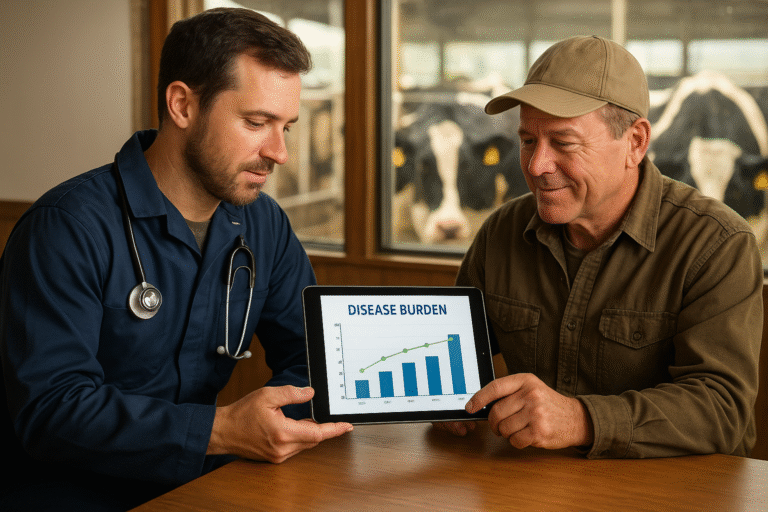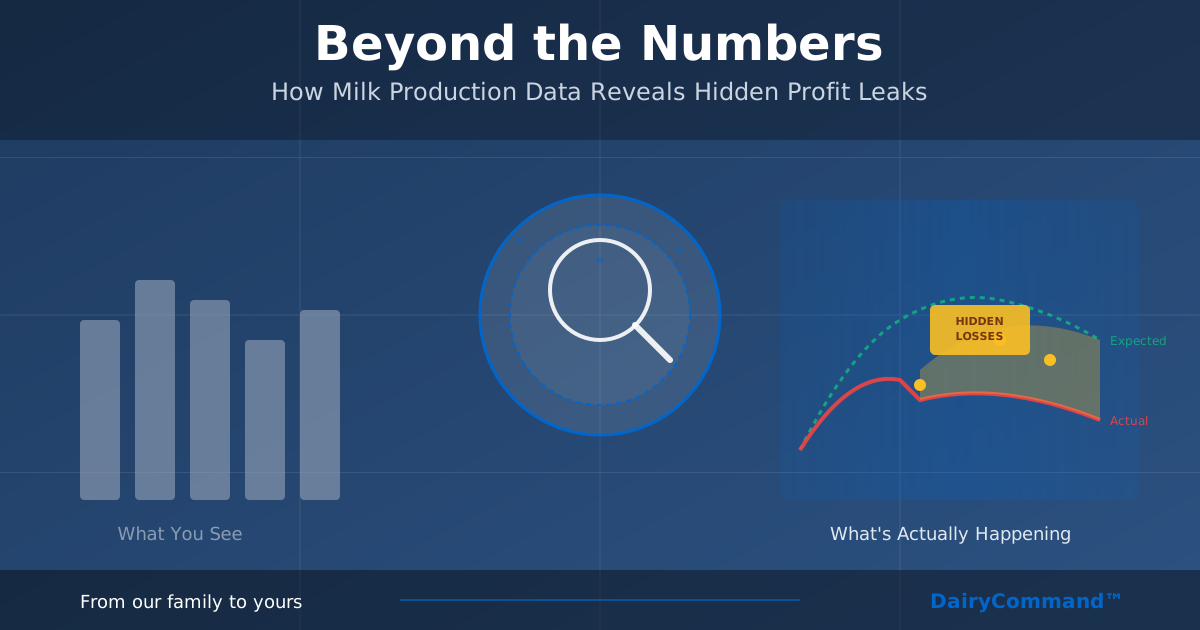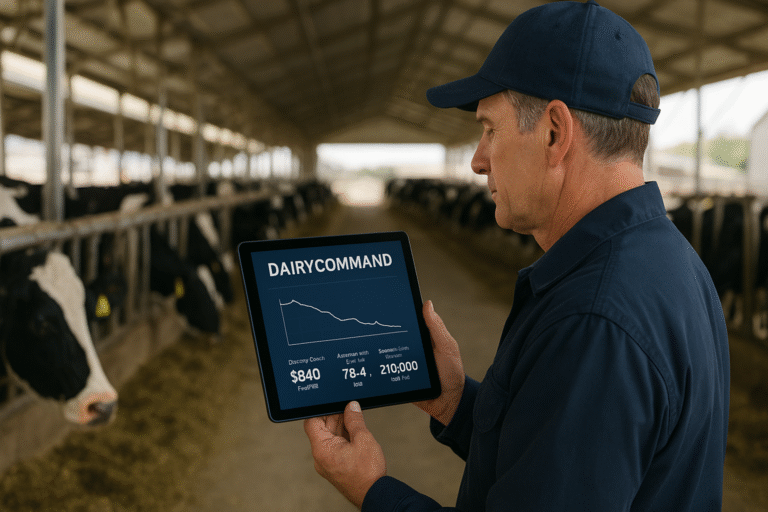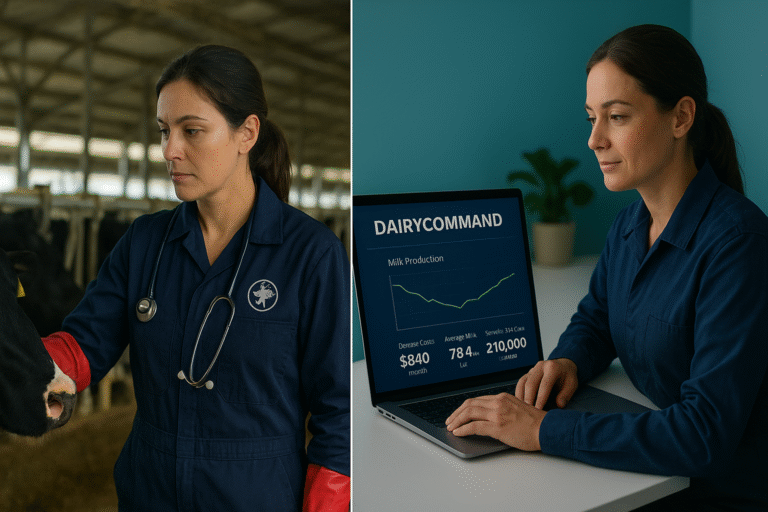

You implement a new mastitis prevention protocol. Six months pass. Your dairy client asks: “Is this working?” Without data, you’re guessing. You might say prevalence went up because detection improved, or down because prevention worked. But what your client really wants to know is whether milk production losses decreased. That’s the ROI question, and until now, most veterinarians couldn’t answer it with hard numbers.
Disease Burden Analysis changes this conversation completely. This tool quantifies disease-specific milk losses at the herd level, establishing a baseline before interventions and tracking outcomes through systematic 6-month monitoring cycles. When you can show a farmer that mastitis cost 25,000 liters last year but dropped to 14,000 liters after your protocol changes, you’ve documented measurable value. No guesswork required.
The Complete Picture: Quantifying Total Herd Milk Loss
The 70,000-Liter Problem Most Farms Don’t See
Consider a 400-cow dairy farm with what appears to be good herd health management. Clinical cases get treated. Protocols exist on paper. Yet hidden beneath the surface, diseases are quietly draining milk production at a staggering scale.
Disease Burden Analysis might reveal that this farm loses 70,000 liters annually across all disease conditions. At $0.50-$0.70 per liter, that represents $35,000 to $50,000 in invisible economic losses. These costs don’t appear in veterinary invoices or medication bills. Financial records capture direct treatment expenses but completely miss the extended production deficits that stretch across entire lactations (Puerto et al., 2021).
Traditional herd management software tracks disease events. It records when a cow had mastitis or went lame. But it doesn’t isolate how much milk that specific disease cost compared to if the cow had stayed healthy. That’s the breakthrough here: quantifying the specific, disease-attributed milk loss rather than just noting that diseases occurred.
Disease-by-Disease Breakdown
When you break down that 70,000-liter total loss by disease, patterns emerge that guide intervention priorities:
Mastitis: 25,000 liters (36% of total loss)
Lameness: 18,000 liters (26%)
Ketosis: 12,000 liters (17%)
Metritis: 8,000 liters (11%)
High SCC: 5,000 liters (7%)
Retained Placenta: 2,000 liters (3%)
Suddenly, veterinary consulting conversations shift from “we should work on herd health” to “mastitis is your biggest opportunity—it’s costing 25,000 liters annually with a worsening 5-year trend.” That specificity enables targeted action rather than general recommendations.
Direct vs. Indirect Losses
Why don’t these losses show up in farm financial records? Because traditional tracking captures only direct costs: discarded milk during treatment, the immediate production drop during acute illness, veterinary bills, and medication expenses. Farmers see those numbers. They’re tangible and recorded.
The larger problem is indirect losses. A cow develops clinical mastitis, gets treated, and appears to recover. But research shows she’ll produce less milk for the remainder of that lactation compared to if she’d never gotten sick (Wilson et al., 2004). That extended deficit isn’t captured anywhere in the farm’s books. It’s invisible—yet it often represents 60-70% of the total economic impact of disease.
Disease Burden Analysis uses statistical algorithms to isolate these disease-specific production deficits across entire 305-day lactation cycles. It compares actual production to what the cow would likely have produced if she’d stayed healthy, controlling for other factors like parity, stage of lactation, and seasonal effects. The result: a comprehensive assessment that includes both the visible direct losses and the hidden indirect costs that traditional systems miss entirely.
From Data to Action: The Intervention Monitoring Cycle
Step 1 – Establish Your Baseline
The first Disease Burden Analysis establishes your starting point. You learn which diseases contribute most to milk losses on that specific farm. Maybe mastitis dominates at 25,000 liters annually. Or perhaps lameness is the primary culprit at 30,000 liters. Every herd is different based on genetics, management, facilities, and geography.
Equally important: the 5-year trend. A disease might cause substantial losses but show an improving trend (green status) because current protocols are working. That’s different from a disease causing high losses with a worsening trend (red status), which signals immediate need for intervention. The traffic light system—red, yellow, green—provides at-a-glance prioritization for where to focus efforts.
Step 2 – Review and Identify Intervention Opportunities
Armed with baseline data, you can review existing protocols against outcomes. If mastitis shows 25,000 liters loss with a red flag status, current prevention isn’t working. Time to ask: What’s the gap?
Common intervention opportunities include:
New prevention programs: Enhanced teat dipping procedures, improved pre-milking hygiene protocols, environmental modifications to reduce pathogen exposure.
Preventative vaccinations: Mastitis vaccines, metritis prevention programs, respiratory disease immunization—when appropriate for herd-specific risk profiles.
Treatment protocol adjustments: Earlier intervention criteria based on California Mastitis Test scores or somatic cell counts, more aggressive treatment of subclinical cases, revised therapeutic approaches for chronic conditions.
Addressing protocol drift: Staff training to restore compliance with established protocols, monitoring systems to catch when procedures slip, management reinforcement of critical practices. Often, good protocols exist on paper but aren’t being followed consistently—that drift shows up in the milk loss data.
Prioritization should balance the magnitude of milk loss, the trend direction, and intervention feasibility. A disease causing 30,000 liters loss with worsening trends demands attention before a disease causing 3,000 liters with stable trends, assuming both have practical intervention options.
Step 3 – Implement Targeted Interventions
Document your intervention start date clearly. This becomes Month 0 in your monitoring timeline. Set measurable targets based on the baseline data. If mastitis currently causes 25,000 liters loss, what’s a realistic reduction target? A 30-40% decrease within 12 months is often achievable with comprehensive protocol improvements.
Communicate the plan clearly to the farm team. Everyone needs to understand what changed and why. This isn’t just about buying into the intervention, it’s about maintaining consistency during the monitoring period so you can accurately attribute any changes to the protocol adjustments rather than random variation.
Step 4 – Monitor Outcomes Through Data
Six months after intervention, run a follow-up Disease Burden Analysis. Why 6 months? That’s the minimum timeframe needed for herd-level biological responses to become measurable. Some diseases respond faster (acute mastitis interventions might show effects in 3-4 months), while others take longer (lameness prevention often requires 6-9 months to fully assess).
Key metrics to track:
Disease-specific milk loss (absolute liters per year): This is your primary success indicator. Did the total annual milk loss from your targeted disease decrease?
Milk loss per disease event: Are individual cases less severe? Effective interventions often reduce both the frequency and severity of disease events.
Acute vs. chronic case ratios: Better early detection might increase acute case counts while decreasing chronic cases—that’s a positive outcome even if total prevalence stays similar.
5-year trend direction: Is the trend line improving (moving toward green status) or continuing to worsen?
Compare everything to baseline. The question isn’t whether prevalence went up or down. The question is whether milk loss decreased. That’s what determines protocol effectiveness and ROI.
Step 5 – Adjust or Validate
If milk loss decreased significantly: Validate that the protocol is working. Document the ROI. Share results with the farm team. Continue the approach. Schedule the next monitoring cycle in another 6 months to ensure sustained improvement.
If milk loss stayed the same or increased: Investigate why. Was the protocol implemented as planned? Did compliance slip? Was the intervention insufficient for the problem’s scale? Did other factors change (new animals introduced, facility issues, seasonal disease pressure)?
The beauty of 6-month cycles is rapid adjustment capability. You don’t waste 2-3 years on an ineffective approach. If something isn’t working, you know within 6 months and can pivot to alternative strategies. That agility is valuable—both economically and for maintaining farmer confidence in your recommendations.
Monitoring Disease Management Effectiveness
The 6-Month Assessment Window
Why do 6-month intervals work well for most disease monitoring? It balances several factors. First, you need enough time for biological responses to manifest at the herd level. Individual cows might respond to treatment changes within days or weeks, but for herd-wide patterns to shift measurably takes months. Second, 6 months captures seasonal variation without waiting so long that other variables confound the results. Third, it maintains engagement—farmers and veterinarians stay connected to the process rather than implementing changes and forgetting about them for years.
Some diseases have different optimal monitoring windows. Ketosis interventions focused on transition cow nutrition might show results in 3-4 months since you’re seeing new cases frequently in fresh cows. Lameness prevention through facility modifications might require 8-9 months to fully assess since mobility issues develop gradually. But 6 months serves as the default recommendation that works well across most disease categories.
What Success Looks Like in the Data
Clear protocol success shows up primarily as reduction in total milk loss from the targeted disease. If mastitis caused 25,000 liters loss at baseline and drops to 15,000 liters after intervention, that’s a 40% reduction—unambiguous success worth $6,000-$7,000 in recovered milk revenue.
Secondary indicators support the primary metric. Fewer chronic or recurring cases suggests better management. Reduced milk loss per disease event indicates faster treatment response or less severe clinical signs. These patterns all point toward protocol effectiveness.
Here’s what’s important to understand: prevalence might go up, down, or stay stable during successful interventions. All three scenarios can represent protocol success depending on circumstances.
Prevalence increases, milk loss decreases: This often indicates better early detection with more effective treatment. You’re catching cases sooner, recording more diagnoses, but preventing those cases from becoming severe production losses. That’s exactly what good disease management looks like.
Prevalence decreases, milk loss decreases: This indicates successful prevention—fewer cows getting sick and less production loss. Classic success pattern.
Prevalence stable, milk loss decreases: This suggests faster or more effective treatment. Same number of cases recorded, but each case causes less production damage because of quicker intervention or better therapeutic approaches.
The throughline: milk loss is what matters. That’s the economic outcome. Prevalence is a supporting metric that provides context, but it’s not the primary success indicator.
When Interventions Don’t Work
Not every protocol change delivers results. That’s reality. The advantage of systematic monitoring is identifying failures quickly rather than continuing ineffective approaches for years. If you implement a new vaccination program for ketosis and 6-month follow-up shows no reduction in milk losses, you know within half a year instead of assuming it’s working for 2-3 years.
Early failure detection prevents three costly problems. First, you stop spending money on interventions that aren’t delivering value. Second, you avoid the opportunity cost of not trying alternative approaches. Third, you maintain farmer confidence by showing you’re responsive to data rather than rigidly committed to a single approach regardless of results.
When interventions don’t work, investigation follows. Was the protocol actually implemented as designed? Staff compliance issues are common. Was the intervention sufficient for the problem’s magnitude? Sometimes the approach is right but the intensity needs adjustment. Did other variables change? New animals introduced, facility modifications, seasonal patterns, or changes in nutrition can all affect disease dynamics.
The 6-month pivot capability is powerful. You might try nutritional ketosis prevention first. If that doesn’t reduce milk losses by 6 months, you can shift to a different prevention strategy or treatment protocol without having wasted years. This agility—combined with documented evidence of why you’re changing approaches—builds farmer trust rather than appearing indecisive.
The Prevalence vs. Milk Loss Relationship
Why Prevalence Changes Aren’t the Primary Metric
Many veterinarians instinctively focus on prevalence as the key disease metric. Lower prevalence equals better herd health, right? Not always. Prevalence tells you how many cows are being diagnosed with a condition, but it doesn’t tell you the economic impact of those diagnoses or whether your management approaches are effective.
Consider three scenarios with mastitis:
Scenario A: A farm implements aggressive early detection using weekly California Mastitis Tests instead of monthly. Prevalence increases from 18% to 24% because they’re catching more subclinical cases early. But annual milk loss drops from 25,000 liters to 15,000 liters because early treatment prevents cases from becoming severe or chronic. This is success even though prevalence went up.
Scenario B: A farm improves teat dipping compliance and milking hygiene. Both prevalence and milk losses decrease—from 20% to 12% prevalence and from 22,000 liters to 10,000 liters loss. Classic prevention success where fewer cows get sick in the first place.
Scenario C: A farm maintains current protocols. Prevalence stays stable at 15%, but they improve treatment speed and effectiveness. Milk loss per case drops because cows recover faster with less extended production deficit. Total milk loss decreases from 18,000 to 12,000 liters even though prevalence didn’t change. Again, this is success.
All three scenarios represent effective disease management with reduced economic losses. But prevalence went up in one, down in another, and stayed flat in the third. That’s why milk loss—not prevalence—is the primary metric for evaluating protocol effectiveness.
Understanding the Four Scenarios
Think of prevalence and milk loss as two independent axes creating a 2×2 matrix. This helps interpret what different patterns mean:
Low prevalence + Low milk loss (Green zone): This is your ideal state. Few cows getting sick, minimal production impact. Good prevention and management working together.
High prevalence + Low milk loss (Yellow-Green zone): This often represents effective early detection with prompt treatment. You’re catching cases early through aggressive monitoring, recording more diagnoses, but preventing those cases from becoming severe production losses. Don’t be alarmed by higher prevalence if milk losses are controlled.
Low prevalence + High milk loss (Red zone): This is concerning. It suggests underdiagnosis or missed subclinical cases. You’re not recording many disease events, but the cases you’re missing or detecting late are causing substantial production deficits. This pattern demands investigation into diagnostic protocols and case detection systems.
High prevalence + High milk loss (Red zone): This indicates poor disease management. Many cows are getting sick AND those cases are causing severe production consequences. Clear need for intervention across prevention, detection, and treatment protocols.
Understanding these patterns helps interpret what changes in prevalence mean during intervention monitoring. If you implement better early detection and prevalence increases while milk losses decrease, that’s moving from Quadrant 1 toward Quadrant 2—which might seem counterintuitive but actually represents improved management.
Communicating Data to Farmers
When presenting Disease Burden Analysis results to farmers, lead with milk loss numbers. That’s what they understand and care about—the economic impact on their operation. “Your mastitis management changes saved 11,000 liters this year—that’s $6,600 in recovered milk revenue” resonates more than discussing prevalence percentages.
If prevalence increased alongside decreasing milk losses, explain that second. “We’re detecting cases earlier now, so recorded prevalence went up from 18% to 24%. But because we’re catching them sooner and treating more effectively, the actual milk loss dropped by 40%. That increased detection is exactly why the protocol is working.”
Frame prevalence increases as diagnostic improvement rather than herd deterioration. Farmers often panic seeing higher case counts without context. Your job is providing that context: better detection prevents worse outcomes, even if it temporarily increases recorded disease events.
Always connect data back to economic outcomes. Numbers matter, but farmers make decisions based on dollars, not liters or percentages. Translate milk losses into revenue impacts at their specific milk price. Show ROI on intervention investments. Demonstrate that your recommendations deliver measurable financial returns, not just theoretical herd health improvements.
Clinical Applications for Veterinary Practice
Expanding Your Consulting Role
Traditional veterinary practice focuses primarily on reactive treatment. A cow gets sick, you diagnose, you prescribe treatment, you move on to the next case. That model positions veterinarians as service providers responding to problems after they occur.
Disease Burden Analysis enables a different role: proactive economic optimization partner. Instead of just treating individual cases, you’re quantifying herd-level disease impacts, designing data-driven intervention strategies, monitoring outcomes, and demonstrating measurable ROI. This positions you as a strategic consultant integral to farm profitability, not just an animal health service provider.
The conversation shifts fundamentally. Rather than “here’s what happened and how we treated it,” you’re discussing “here’s what diseases are costing your operation, here’s what we could do about it, and here’s how we’ll measure whether our approach is working.” That’s a consulting relationship, not a transactional service relationship. It changes how farmers view your value and how they engage with your recommendations.
This expanded role opens new revenue opportunities for veterinary practices. Herd health optimization consulting can be structured as annual retainer services. Protocol effectiveness validation becomes a distinct service offering. Intervention monitoring packages at 6-month and 12-month intervals create ongoing engagement. You’re not just billing for individual farm visits—you’re providing strategic advisory services that command higher value because they deliver documented financial returns.
Demonstrating ROI to Dairy Clients
ROI documentation transforms veterinary recommendations from costs to investments. When you can show concrete numbers, farmers see protocol improvements differently.
Here’s a typical ROI scenario using Disease Burden Analysis:
Baseline: Mastitis causing 25,000 liters annual milk loss
Intervention cost: $3,000 for enhanced detection program plus staff training
12-month outcome: Milk loss reduced to 14,000 liters (11,000L saved)
Financial return: 11,000L × $0.60/L = $6,600 revenue recovered
Net ROI: $6,600 return – $3,000 cost = $3,600 net benefit (120% return in first year)
Ongoing benefits: Sustained lower milk losses in subsequent years without repeating initial investment
Those numbers make decisions easy for farmers. A 120% first-year return on investment isn’t marginal—it’s compelling. And because the data shows specifically what worked, farmers gain confidence in continued investment in herd health protocols.
Compare this to recommendations without quantified outcomes. “You should improve your mastitis prevention program” sounds like an expense. “Improving mastitis prevention could save you 10,000 liters annually—that’s $6,000 in recovered revenue against a $3,000 investment” sounds like an opportunity. Same recommendation, completely different framing enabled by quantified data.
The ongoing monitoring capability adds another layer of value. You’re not just implementing something and hoping it works. You’re documenting that it worked, showing the farmer exactly what they gained, and building a track record of delivering measurable value. That creates long-term client relationships based on demonstrated results rather than assumed benefits.
Prioritizing Where to Focus Efforts
When Disease Burden Analysis reveals problems across multiple diseases, prioritization becomes essential. You can’t tackle everything simultaneously, and farmers have limited capacity for implementing multiple protocol changes at once.
The traffic light system provides initial guidance. Red flags—diseases with high losses AND worsening 5-year trends—demand immediate attention. These represent both substantial current economic impact and deteriorating situations that will only get worse without intervention. Yellow flags indicate stable but significant losses that warrant monitoring and potential intervention. Green flags show improving trends or minimal losses where current protocols are working.
But prioritization isn’t just about flag colors. Consider intervention feasibility and farmer readiness. A disease causing 30,000 liters loss might be red-flagged, but if the intervention requires expensive facility modifications the farmer can’t afford, it might need to wait. Meanwhile, a disease causing 15,000 liters loss with a straightforward vaccination or protocol adjustment might be the better starting point—achieving a “quick win” that builds farmer confidence in the data-driven approach.
Strategic sequencing matters too. Some interventions create foundations for others. Improving transition cow nutrition might address ketosis directly while also reducing metritis risk and improving reproductive performance. Tackling that first could have cascading benefits across multiple disease categories. Other interventions are independent—mastitis prevention protocols don’t directly affect lameness outcomes, so these can be addressed separately based on priority and resources.
Work with farmers to align priorities with their capacity for change. Some farmers are highly motivated and can implement multiple changes simultaneously. Others need incremental approaches with proven results at each step before committing to additional investments. The data enables strategic conversations about sequencing and resource allocation rather than generic “you should improve everything” recommendations that overwhelm and paralyze decision-making.
Case Example: Monitoring Mastitis Protocol Changes
This is a hypothetical scenario illustrating how Disease Burden Analysis monitoring would work in practice. As we’re currently in pilot phase, this represents how the tool could be used rather than a completed client analysis.
Baseline Assessment (Month 0)
Consider a 400-cow dairy farm, primarily Holsteins, with what appears to be typical mastitis management. They’re using standard teat dipping, have basic hygiene protocols, and treat clinical cases as they arise. Nothing obviously wrong, but the Disease Burden Analysis reveals a different picture.
Mastitis findings:
Annual milk loss: 25,000 liters
Five-year trend: Worsening (RED status)
Current prevalence: 18%
Chronic/recurring cases: 40% of total cases
Economic impact: $15,000-$17,500 annually in invisible losses
The veterinary assessment identifies late detection as the primary issue. Many cases aren’t caught until cows show obvious clinical signs. By then, the infection has been present for weeks, causing extended production deficits. The chronic case percentage confirms this—these are infections that weren’t resolved effectively on first treatment, often because they weren’t caught early enough.
Intervention Implementation (Months 1-6)
Based on the baseline data, the veterinarian and farmer develop a three-part intervention strategy:
Enhanced California Mastitis Test (CMT) screening: Move from monthly testing to weekly testing for all cows. This increases labor commitment but catches subclinical cases much earlier—typically 2-4 weeks before they’d become clinically obvious.
Earlier treatment initiation criteria: Lower the somatic cell count threshold for treatment initiation. Previously, they waited until SCC exceeded 400,000 cells/mL. New protocol: intervene at 250,000 cells/mL. This treats more cows earlier, potentially using more medication, but prevents infections from becoming established and chronic.
Staff retraining on hygiene protocols: Audit reveals protocol drift—pre-milking teat sanitation compliance had slipped to about 60% of cows. Staff retraining and daily compliance monitoring restore this to 95%+ compliance. This addresses prevention alongside improved detection and treatment.
Total intervention cost: $2,800 for program implementation (staff training, additional testing supplies, time investment for increased screening frequency)
Implementation takes 4-6 weeks to reach full compliance. By Month 2, the enhanced protocols are running consistently. The farm commits to maintaining this approach through the 6-month monitoring period to allow fair assessment.
6-Month Follow-Up Analysis
Six months after intervention, a follow-up Disease Burden Analysis quantifies outcomes:
Mastitis milk loss: 17,000 liters (32% reduction from 25,000L baseline)
Prevalence: 22% (increased from 18%)
Chronic/recurring cases: 18% of total cases (decreased from 40%)
Economic impact: $10,200-$11,900 annually (substantial reduction)
Interpretation: The intervention is clearly working. Total milk loss decreased by 8,000 liters despite prevalence increasing. That prevalence increase reflects better detection—the weekly CMT screening is catching more cases. But because those cases are being caught and treated earlier, they’re causing far less production damage. The dramatic drop in chronic cases (from 40% to 18%) confirms this—fewer infections are persisting because they’re being resolved on first treatment.
The farmer’s initial reaction: concern about prevalence going up. The veterinarian explains this is actually evidence of success. “We’re recording more cases because we’re finding them sooner. But look at what matters—you’ve recovered 8,000 liters of milk production. That’s $4,800 to $5,600 in recovered revenue against a $2,800 investment. And we’re just at 6 months. If this continues, your annual savings will be even greater.”
The data validates the protocol changes and justifies continuing the approach. Both farmer and veterinarian have confidence the investment is delivering returns.
12-Month Final Assessment
At 12 months post-intervention, the final assessment shows sustained and improved results:
Mastitis milk loss: 14,000 liters (44% total reduction from 25,000L baseline)
11,000 liters saved compared to baseline
Prevalence: 20% (stabilizing after initial increase)
Chronic/recurring cases: 12% of total cases
Five-year trend: Improving (moving from RED toward YELLOW status)
ROI calculation:
Milk saved: 11,000 liters
Revenue recovery: 11,000L × $0.60/L = $6,600
Intervention cost: $2,800
Net benefit: $3,800 (136% return on investment in first year)
Ongoing benefit: Sustained lower losses in subsequent years without repeating initial investment
The farmer’s verdict: “This is the first time I’ve actually seen proof that a protocol change worked. Not just your opinion or my gut feeling—actual numbers showing we saved milk and made money. I’m keeping this program going.” The veterinarian has documented value delivery, strengthened the client relationship, and demonstrated the economic consulting role beyond traditional reactive treatment.
Integrating Disease Burden Analysis into Practice
Data Requirements and Automation
Disease Burden Analysis integrates with DC305/DairyComp data pipelines that most North American dairies already use. The system pulls 5 years of retrospective data to establish historical trends and provide context for current findings. That historical depth enables the traffic light system—you can’t identify worsening or improving trends without years of comparison data.
The analysis itself is nearly fully automated from data extraction through report generation. Currently in pilot phase, the tool will eventually require minimal veterinary time investment after initial setup. You’re not manually calculating milk losses or running statistical models. The algorithms handle multi-disease attribution, distinguishing acute from chronic cases, and isolating disease-specific effects even when cows experience multiple concurrent conditions (Rasmussen et al., 2024).
This automation is critical for practical veterinary use. You can’t spend hours manually analyzing each farm’s data. The tool needs to generate actionable insights efficiently so you can focus on interpretation, recommendation, and implementation support—the high-value consulting activities that farmers need from you.
Disease Coverage
The analysis currently covers the major dairy diseases that account for most production losses:
Mastitis (acute and chronic/recurring cases)
Lameness (with breakdown by specific mobility conditions when data available)
Elevated Somatic Cell Count (separate from clinical mastitis)
Ketosis (clinical and subclinical when detected)
Metritis
Retained Placenta
Abortions
The underlying algorithms analyze all recorded disease events in the herd management system. These seven conditions are reported by default because they typically drive the majority of disease-related milk losses. But the system is expandable to other diseases as needed based on regional disease patterns or specific farm concerns. If a particular herd faces significant problems with respiratory disease or displaced abomasum, those can be incorporated into the analysis.
For lameness, when farm records include specific mobility scores or condition diagnoses, the analysis can break down losses by digital dermatitis, sole ulcers, white line disease, and other specific lameness conditions. This specificity helps target interventions precisely—strategies for preventing digital dermatitis differ from those for sole ulcers, and knowing which condition drives most losses enables focused action.
Interpreting Report Outputs
Disease Burden Analysis reports use several formats to make data accessible for both veterinarians and farmers:
Traffic light system: Each disease gets a red, yellow, or green status based on its milk loss magnitude and 5-year trend direction. Red means high losses with worsening trends—immediate intervention recommended. Yellow indicates stable but significant losses requiring monitoring. Green shows improving trends or minimal losses where current management is working.
Bar charts: Visual representation showing each disease’s contribution to total herd milk loss. These quickly communicate which diseases matter most economically. A bar chart instantly shows that mastitis represents 36% of total losses while retained placenta accounts for only 3%—guiding where to focus efforts.
5-year trend graphs: Line graphs showing how milk losses from each disease have changed over the past five years. These reveal whether problems are getting better, worse, or staying stable—essential context for understanding whether current protocols are working or need adjustment.
Detailed data tables: Comprehensive tables providing specific numbers—annual milk loss per disease, disease prevalence rates per year, estimated milk loss per disease event (separated into acute and chronic cases), and breakdowns by parity or disease subtype where relevant.
The combination of visual and numerical formats makes the reports work for different audiences. Farmers often respond better to visual traffic lights and bar charts that communicate priorities at a glance. Veterinarians might want the detailed tables to understand methodology and assess specific interventions. Having both ensures everyone can engage with the data at their preferred level of detail.
Conclusion
Disease management effectiveness is now quantifiable. Disease Burden Analysis moves veterinary consulting from educated guesswork to data-driven precision. You can identify which diseases cause the greatest economic losses on specific farms, design targeted interventions, monitor outcomes through systematic 6-month cycles, and document ROI that proves your recommendations deliver measurable value.
The monitoring approach transforms how farmers view protocol changes. Instead of implementing interventions and hoping they work, you establish baselines, track milk loss reduction, and validate effectiveness with hard numbers. When you can show a farmer that mastitis management improvements saved 11,000 liters annually—worth $6,600 in recovered revenue—you’re documenting strategic value, not just providing animal health services.
This positions veterinarians as essential economic optimization partners rather than reactive service providers. Your role expands from treating sick cows to optimizing herd health economics through evidence-based interventions with measurable outcomes. That’s a consulting relationship that creates long-term value for both farmers and veterinary practices.
From our family to yours: we built Disease Burden Analysis because veterinarians deserve tools that prove your value and farmers deserve confidence that protocol investments deliver returns. Learn more about systematic disease monitoring and intervention tracking at our Disease Burden Analysis tool page.
References
Cha, E., Hertl, J.A., Bar, D., and Gröhn, Y.T. (2010). The cost of different types of lameness in dairy cows calculated by dynamic programming. Preventive Veterinary Medicine, 97(1), 1-8. https://www.sciencedirect.com/science/article/abs/pii/S0167587710002102
Puerto, M.A., Shepley, E., Cue, R.I., Warner, D., Dubuc, J., and Vasseur, E. (2021). The hidden cost of disease: I. Impact of the first incidence of mastitis on production and economic indicators of primiparous dairy cows. Journal of Dairy Science, 104(7), 7932-7943. https://www.journalofdairyscience.org/article/S0022-0302(21)00510-5/fulltext
Rasmussen, P., Barkema, H.W., Osei, P.P., Taylor, J., Shaw, A.P., Conrady, B., Chaters, G., Muñoz, V., Hall, D.C., Apenteng, O.O., Rushton, J., and Torgerson, P.R. (2024). Global losses due to dairy cattle diseases: A comorbidity-adjusted economic analysis. Journal of Dairy Science, 107(9), 6945-6970. https://www.journalofdairyscience.org/article/S0022-0302(24)00821-X/fulltext
Wilson, D.J., González, R.N., Hertl, J., Schulte, H.F., Bennett, G.J., Schukken, Y.H., and Gröhn, Y.T. (2004). Effect of clinical mastitis on the lactation curve: a mixed model estimation using daily milk weights. Journal of Dairy Science, 87(7), 2073-2084. https://www.sciencedirect.com/science/article/pii/S0022030204700259
Related Resources:
About DairyCommand
From our family to yours: DairyCommand was built by veterinarians and data scientists who understand both clinical excellence and farm economics. Our platform transforms complex herd data into clear, actionable insights that help you provide strategic value to your dairy clients. We believe veterinarians deserve tools that prove your recommendations work—not through opinions, but through documented milk production recovery and measurable ROI. Learn more about our veterinary consulting tools at signal2action.com.