Why Lifetime Data Beats Single Lactation Records
Introduction
You check your latest test day results. Cow #847 produced 75 pounds yesterday. Solid numbers.
But here’s what those numbers don’t tell you: she’s had three bouts of mastitis across four lactations, her actual lifetime milk production is 15% below herd average, and she’s quietly costing you $400 annually compared to your top performers.
Most dairy farmers make breeding and culling decisions based on recent production snapshots. Current lactation. Last test day. This month’s performance. Those snapshots hide the bigger picture and the bigger profit opportunities.
Dairy cow lifetime milk production data reveals which cows are truly profitable and which ones are holding your operation back. You’ll learn why tracking full production history changes everything about herd management, how to identify cows that look good today but cost money over time, and practical steps to use lifetime data for decisions that improve your bottom line and build a stronger herd for the next generation.
What Cow Lifetime Milk Production Actually Measures
Lifetime milk production tracks every pound of milk a cow produces from first calving until she leaves your herd. Single lactation records only show current performance. Lifetime data captures the complete story.
Here’s what you’re measuring:
Total milk across all completed lactations. Average daily production over her entire productive life. Production consistency between lactations. Recovery patterns after health events or difficult calvings.
A cow producing 70 pounds today might have averaged 85 pounds in her first two lactations before declining. Another cow at 70 pounds might be improving with each lactation. Same current number, completely different long-term value (Perneel et al., 2024).
Lifetime data also reveals hidden costs that test day sheets miss. A cow with chronic subclinical mastitis might maintain acceptable production in her current lactation, but lifetime tracking shows she’s never reached the performance of healthy herdmates. That gap represents lost income that compounds across years (Puerto et al., 2021).
Why Single Lactation Records Miss Critical Profit Information
Traditional herd management focuses on current lactation performance. You breed the high producers, cull the obvious underperformers, and hope for the best with everyone in between. This approach leaves money on the table.
Single lactation records can’t tell you:
Whether today’s high producer has been declining steadily across multiple lactations. If a cow consistently underperforms compared to herdmates, even when she looks “average” in isolation. How health events in previous lactations continue affecting current production. Which cows recover well from challenges and which never bounce back.
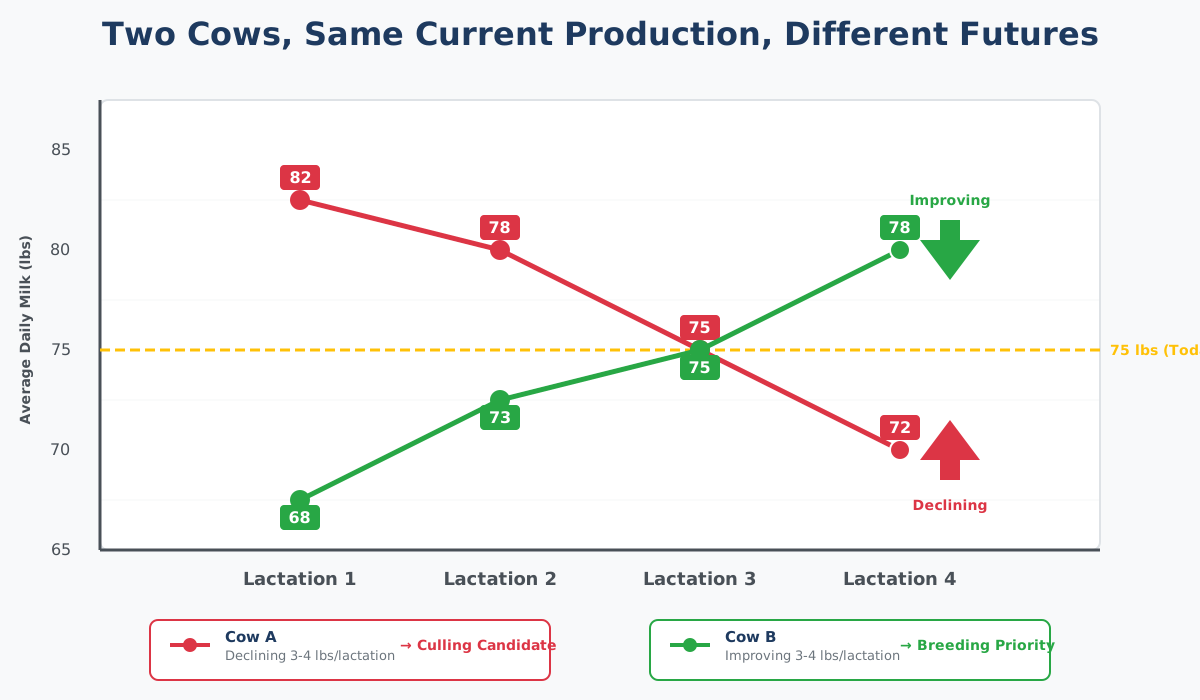
Consider two cows, both producing 75 pounds today:
Cow A: First lactation, 82 pounds average. Second lactation, 78 pounds. Third lactation (current), 75 pounds. She’s declining 4 pounds per lactation.
Cow B: First lactation, 68 pounds average. Second lactation, 73 pounds. Third lactation (current), 75 pounds. She’s improving 4 pounds per lactation. Looking only at current production, these cows appear identical. Lifetime data shows Cow A is headed toward culling while Cow B is still improving. That distinction determines breeding decisions, culling timing, and your profitability.
How Cow Lifetime Milk Production Data Reveals Your True Top Performers
Your best cows aren’t necessarily your highest producers today. True top performers combine high lifetime milk production with consistency, disease resilience, and reproductive efficiency across multiple lactations.
Lifetime data helps you identify cows who:
Maintain production above herd average across all lactations. Recover quickly from health events without extended milk loss. Improve or stabilize production rather than declining steadily. Combine strong genetics with proven performance over time.
These are the cows worth breeding with sexed semen. These are the animals whose daughters and granddaughters will strengthen your herd for decades. You can’t identify them from a single test day or even a single lactation.
Consider a scenario on your farm where the “star cow” based on current production had lifetime numbers 8% below herd average when accounting for her complete history. A consistent mid-producer ranked in the top 15% for lifetime performance. The difference in breeding value between these animals is substantial.
When you track lifetime milk production, you stop breeding cows based on just their genetic potential and start building genetic improvement into your herd’s foundation by combining the genetic potential with real performance. That’s how you pass a stronger operation to the next generation.
Understanding Cow Lifetime Milk Production vs. Lactation Performance
Many farmers confuse lifetime milk production with simply adding up lactation totals. Real lifetime analysis goes deeper. It benchmarks each cow against herd averages and reveals patterns invisible in raw numbers.
Key metrics beyond total lifetime milk:
Average daily production compared to herdmates who calved in the same period. Production trajectory (improving, stable, or declining across lactations). Resilience (how production responds to health events, difficult calvings, or management changes). Longevity potential (whether the cow maintains productivity or fades early).
A cow with three lactations totaling 75,000 pounds sounds productive. But if your herd average for three lactations is 82,000 pounds, she’s underperforming by 7,000 pounds. That’s $1,400 to $2,100 in lost revenue depending on milk price. This analysis also reveals which “problem cows” are actually good performers in context. A cow producing 65 pounds might seem low until you realize she’s in her first lactation, calved late, and is trending upward. Context transforms data from confusing numbers into clear decisions.

Practical Applications: Using Lifetime Data for Culling Decisions
Culling decisions cost money or make money depending on timing. Cull too early and you lose productive years. Cull too late and you’re feeding unproductive animals while missing opportunities to bring in better replacements.
Lifetime milk production data shows you exactly when culling makes financial sense. Instead of guessing based on this month’s production or last week’s health event, you see the complete picture.
Consistent decline across multiple lactations despite good management. Lifetime production 10-15% below herd average with no improvement trajectory. Extended recovery periods after health events that never return to pre-event production levels. High production in first lactation but steady drops afterward.
Here’s a real example. A farmer kept Cow #923 for five lactations because she “wasn’t causing problems” and maintained 68-70 pounds per lactation. Lifetime analysis revealed she’d been 12% below herd average for her entire productive life.
By selling her as a productive dairy animal (not beef) to a smaller operation where she’d be average, the farmer captured $1,200 more than waiting until she truly declined. That early sale funded a replacement heifer who, three years later, is producing 15% above herd average.
This is the power of lifetime data. Culling shifts from a reactive “get rid of the worst” decision into a strategic “optimize the herd” decision.
Building a Stronger Herd with Lifetime-Based Breeding Strategies
Breeding decisions built on lifetime data create compounding improvements. Each generation becomes more productive, more resilient, and more profitable than the last.
Strategic breeding using lifetime production insights:
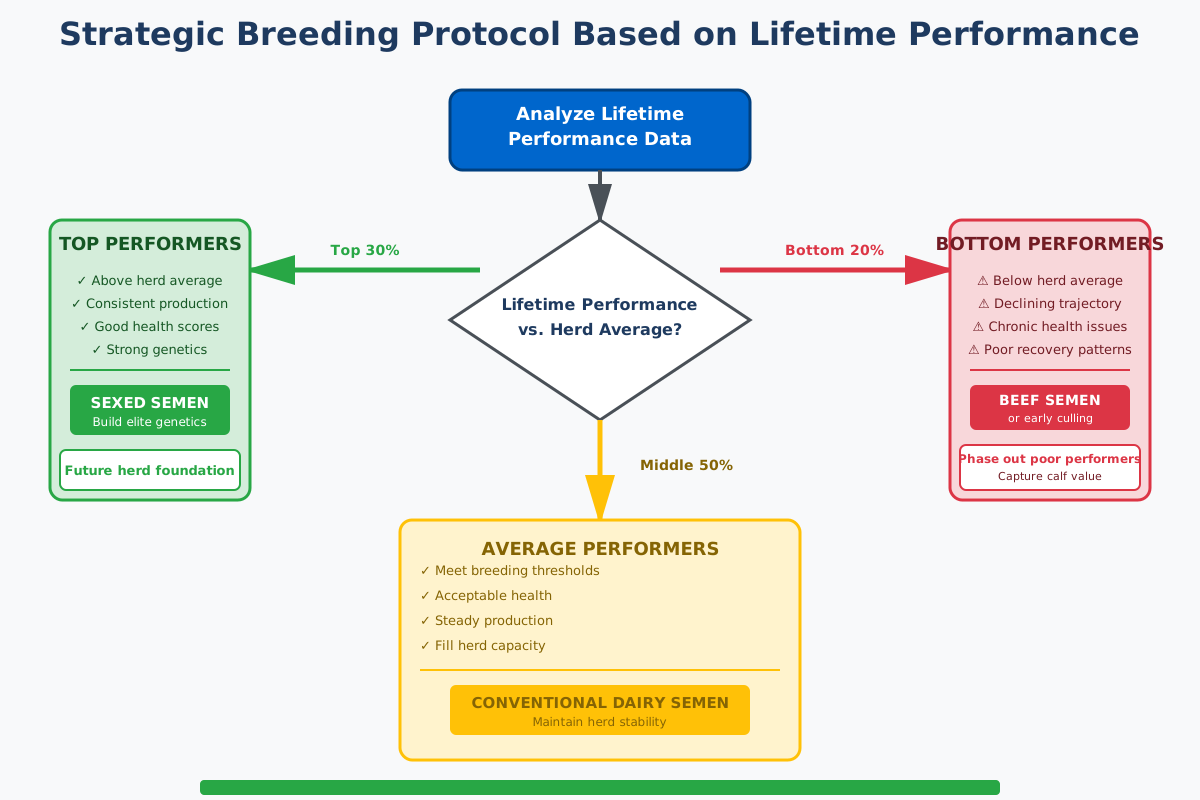
Reserve sexed semen for cows with proven lifetime performance above herd average. Use conventional semen on average lifetime performers who meet breeding thresholds. Consider beef semen for bottom performers to capture calf value while phasing them out.
This approach differs from breeding “whoever looks good today.” You’re building genetic strength into your herd based on complete performance records.
Consider a farm that implemented lifetime-based breeding criteria. The tools could identify 30% of their herd as top lifetime performers (above herd average across all lactations, good health scores, consistent production). These cows were considered to receive sexed semen exclusively. Another 50% qualified for conventional dairy semen. The bottom 20% (including some cows producing acceptable milk today) could receive beef semen or were culled before breeding.
Three years later, the farm’s average lifetime milk production per cow could increase 4%. The herd size could shrink 8% while maintaining the same total production. Feed costs would drop. Labor efficiency would improve. The genetic quality of the replacement heifers would jump significantly.
That’s not magic. It’s what happens when you align breeding decisions with lifetime performance data instead of monthly snapshots.
Red flags in lifetime data that signal culling candidates:
Taking Action: Next Steps for Your Operation
Understanding lifetime milk production matters, but applying it to your herd drives results. Start with these practical steps.
Immediate actions:
Request lifetime production reports from your herd management software. If you use DairyComp or similar systems, this data already exists. You just need to analyze it.
Identify your current top 25% and bottom 25% based on lifetime performance benchmarked against herd averages. Compare these rankings to breeding and culling decisions you’ve made recently. Where are the gaps?
Strategic implementation:
Establish lifetime performance thresholds for breeding decisions. Which cows qualify for sexed semen? Determine which get conventional semen? Identify which cows should leave the herd?
Review these thresholds quarterly and adjust culling timing based on individual cow lifetime trajectories, not just current production. Track improvement over time. Are your breeding decisions increasing average lifetime milk production across the herd?
The goal isn’t perfection in your first year. It’s steady improvement. Each breeding season aligned with lifetime data strengthens your herd. Each culling decision based on complete performance history instead of recent results improves profitability.
Your herd five years from now will reflect the decisions you make today. Lifetime production data ensures those decisions build toward a stronger, more profitable operation. One you’ll be proud to pass to the next generation.
Preview Dairy Production Software for Cow Performance Ranking System
Ready to see how your herd’s lifetime performance compares to its potential? Learn how DairyCommand’s Cow Performance Ranking system analyzes lifetime milk production, health history, genetics, and reproduction to identify your true top performers and reveal hidden profit opportunities.
References
Perneel, M., De Smet, S., and Verwaeren, J. (2024). Data-driven prediction of dairy cattle lifetime production and its use as a guideline to select surplus youngstock. Journal of Dairy Science, 107(11), 9390-9403. https://doi.org/10.3168/jds.2023-23660
Puerto, M. A., Shepley, E., Cue, R. I., Warner, D., Dubuc, J., & Vasseur, E. (2021). The hidden cost of disease: I. Impact of the first incidence of mastitis on production and economic indicators of primiparous dairy cows. Journal of dairy science, 104(7), 7932–7943. https://doi.org/10.3168/jds.2020-19584