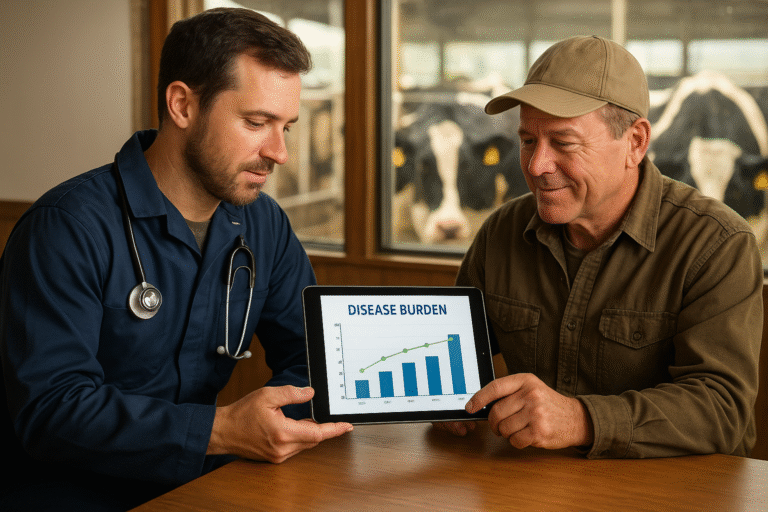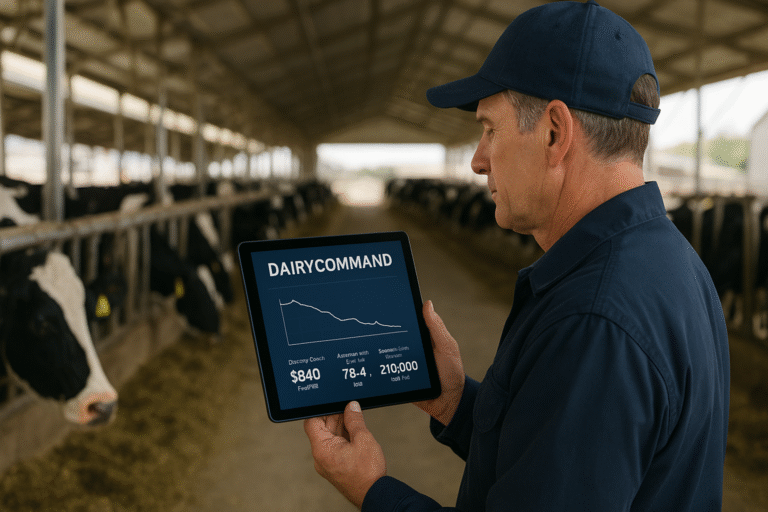

You implement a new ketosis prevention protocol in January. Spring arrives, then summer passes. Your dairy client asks in August: “Is this working?” Without systematic data, the answer remains uncertain. You might observe fewer clinical cases, but did the intervention actually reduce milk production losses? That’s the economic question dairy farmers care about, and until recently, most veterinarians lacked the tools to answer it with quantified evidence.
Disease burden monitoring changes this conversation fundamentally. By assessing herd-level milk loss from disease every six months, veterinarians gain a structured framework for turning clinical data into economic intelligence. This isn’t just faster reporting—it’s biologically and financially optimized timing that transforms disease monitoring from descriptive case tracking into a decision-intelligence layer for strategic herd health management.
The question isn’t whether to monitor disease impact. Progressive veterinary practices already do this. The question is how often. Six-month assessment cycles represent the sweet spot where data becomes actionable intelligence.
From Case Counting to Economic Intelligence: The Decision-Intelligence Layer
Traditional disease monitoring focuses on prevalence rates. You track how many cows are diagnosed with mastitis, ketosis, or lameness each month. These numbers appear in herd management reports, get discussed at annual reviews, and inform general impressions about herd health status. But prevalence data lacks economic meaning.
Consider this scenario: Farm A records 22 clinical mastitis cases this year. Farm B records 15 cases. Which farm has better mastitis management? The answer depends entirely on factors prevalence can’t reveal. What was the severity of each case? How much milk production did these infections cost? Did cases resolve quickly or become chronic recurring problems? Prevalence counts cases but doesn’t quantify consequences.
This is where dairy management systems that incorporate disease burden analysis create value. They convert case counts into milk loss metrics—the economic language that actually drives farm-level decisions. Instead of reporting “22 mastitis cases,” the intelligence layer reveals “mastitis cost this farm 18,000 liters annually—that’s $10,800 in invisible production losses at current milk prices.” That number means something to dairy farmers. It connects clinical observations to financial outcomes (Puerto et al., 2021).
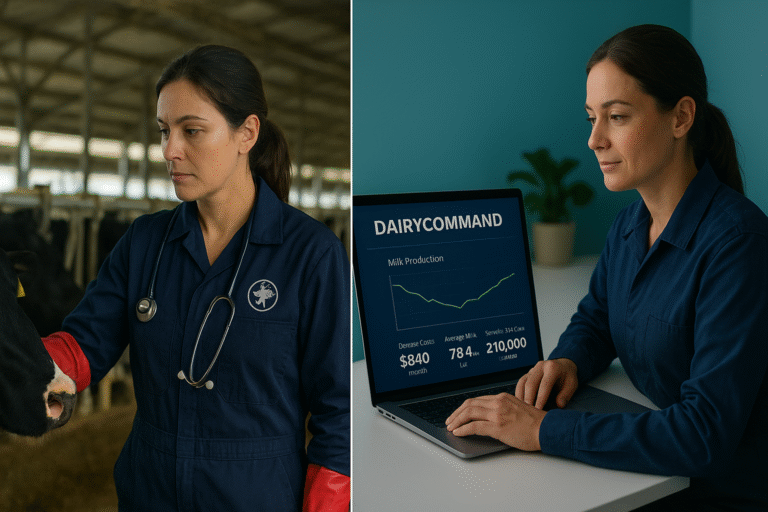
The concept of a decision-intelligence layer is important here. Disease burden monitoring sits between raw data and strategic decisions. On one side, you have daily case records, production test results, and treatment histories flowing into DC305 or DairyComp systems. On the other side, you need intervention decisions: which disease management protocols to implement, where to invest limited resources, whether current approaches are working. The intelligence layer aggregates, analyzes, and quantifies what disease events actually cost in production terms.
Veterinarians gain reliable intelligence that integrates three data streams: disease events (what happened clinically), production data (how milk yields responded), and economic models (what those production changes cost). Each six-month assessment becomes a clinical-economic checkpoint. You’re not just asking “What diseases occurred?” You’re answering “What did they cost, and did our management actions work?”
This differs fundamentally from three traditional approaches. Case counting systems focus on prevalence but lack economic context—you know diseases happened but not their financial impact. Annual reviews provide broad summaries but move too slowly to inform adaptive management—by the time you identify problems, farms have already absorbed thousands of dollars in preventable losses. Real-time alert systems deliver daily detail but prove too granular and noisy—individual cases fluctuate randomly, making it hard to distinguish meaningful trends from normal variation.
Disease burden analysis operated on six-month cycles adds value to all three. It converts cases into milk-loss metrics. The timing supports adaptive planning rather than retrospective reporting. Aggregated intelligence identifies meaningful trends while filtering out noise. This is the decision-intelligence layer that transforms monitoring from recording what happened to guiding what should happen next.
Why 6 Months? The Biological and Financial Sweet Spot
Six-month assessment intervals aren’t arbitrary. This timing represents biological and financial optimization—balancing data robustness with clinical relevance and intervention agility. Understanding why six months works requires examining both the science of dairy cow physiology and the economics of farm management.
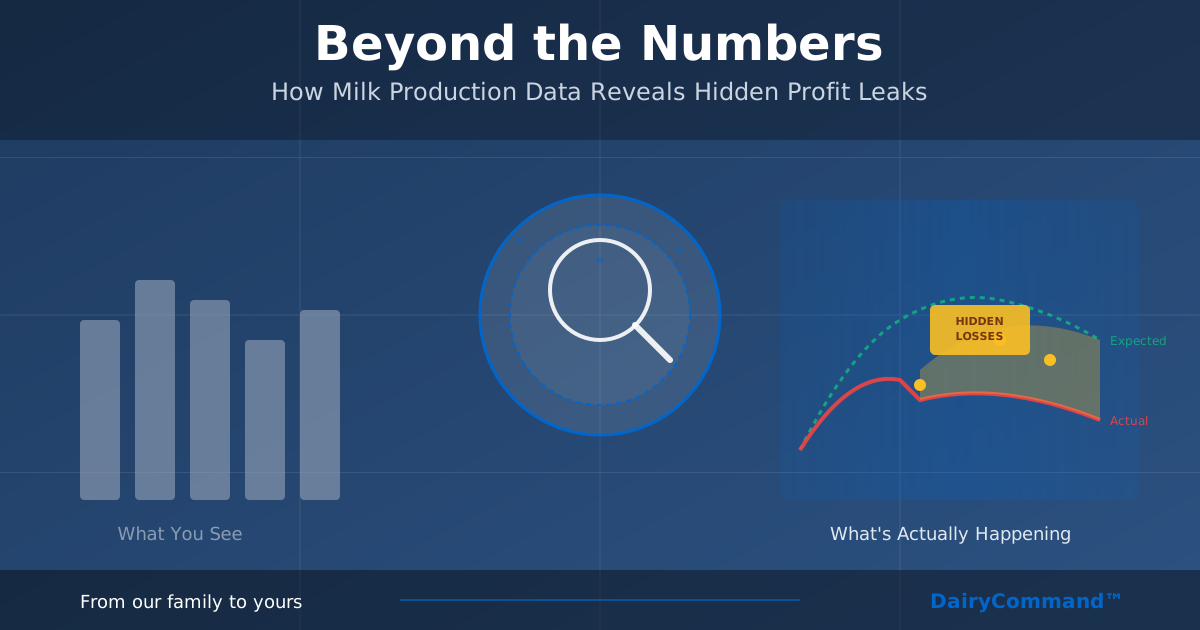
From a biological perspective, six months captures full disease-recovery cycles for most dairy conditions. Mastitis, ketosis, metritis, and lameness all manifest effects across three-to-six-month timeframes when you consider both acute impacts and extended production deficits. A cow develops clinical mastitis in March. She gets treated, appears to recover within two weeks, and returns to the milking string. Traditional monitoring records this as a resolved case. But research shows she’ll likely produce less milk through June, July, and August compared to if she’d never gotten sick (Wilson et al., 2004). That extended deficit takes months to fully manifest in herd-level data.
Six months provides enough time to smooth out random variation while maintaining statistical confidence. Weekly or monthly snapshots prove too noisy. Individual cows fluctuate in production for dozens of reasons unrelated to disease: stage of lactation, weather, feed quality changes, reproductive status, social hierarchy shifts. These factors create short-term variability that can mask or exaggerate disease impacts. Six-month aggregation captures sufficient sample size—enough cows, enough lactation cycles, enough data points—to distinguish true disease-related trends from random noise.
The timing also encompasses meaningful lactation segments. Dairy cows typically lactate for 305 days, divided roughly into early lactation (first 100 days), mid-lactation (days 100-200), and late lactation (days 200-305). Six months covers approximately 180 days, capturing either the critical early-to-mid transition or the mid-to-late progression. This matters because disease impacts vary by lactation stage. Ketosis predominantly affects fresh cows in the first month. Mastitis risk peaks in early and late lactation. Lameness can emerge anytime but often worsens progressively. Six-month windows let you assess stage-specific disease dynamics without waiting so long that multiple lactation cohorts confound interpretation.
Seasonal variation gets captured without requiring multi-year waits. Spring grass transitions differ from fall feed transitions. Heat stress affects summer months. Winter housing creates different disease pressure than pasture season. A six-month window typically spans two distinct seasonal periods—spring to fall, or fall to spring—allowing assessment of how disease patterns respond to environmental changes. You don’t need three years of data to identify seasonal trends when each six-month cycle reveals one complete seasonal transition.
Financial relevance matters equally. Six-month detection limits cumulative economic damage when interventions aren’t working. Consider a mastitis prevention protocol that fails to reduce milk losses. With annual monitoring, you implement in January but don’t assess effectiveness until next January. That’s 12 months of continued losses—potentially $20,000 to $30,000 in preventable milk production deficits on a 400-cow dairy. Six-month monitoring reveals the problem by July. You’ve absorbed only half that loss before pivoting to a different approach. The economic difference between 6-month and 12-month detection can easily exceed $15,000 per farm annually.
This timing aligns perfectly with farm financial planning cycles. Most dairy operations review budgets and make major management decisions semi-annually. Spring planning (March-April) addresses the upcoming grass season, breeding strategies for summer, and preparations for fall. Fall planning (September-October) focuses on winter housing, feed inventory management, and financial positioning for year-end. Disease burden assessments that coincide with these planning windows provide intelligence exactly when farmers are making resource allocation decisions. Data becomes actionable immediately rather than arriving between decision cycles.
The interval validates ROI within timeframes that maintain engagement. Farmers and veterinarians need to see measurable results to justify continued investment in prevention protocols. Six months strikes the right balance. It’s patient enough to give interventions time to work—you’re not abandoning effective approaches prematurely. Yet it’s quick enough to maintain momentum and prove value before commitment wavers. Asking farmers to trust a protocol for 12-18 months without evidence creates skepticism. Showing measurable improvement at 6 months builds confidence that sustains multi-year improvement programs.
Alternative intervals have clear limitations. Three-month cycles prove too short for most herd-level biological responses. Individual cows might respond to treatment changes within days or weeks, but herd-wide patterns take longer to stabilize measurably. You risk high noise-to-signal ratios where random variation dominates true trends. Twelve-month cycles, the traditional annual review approach, move too slowly for competitive dairy markets. By the time you identify that a protocol isn’t working, a full year of losses has accumulated and farmer confidence in data-driven recommendations has eroded. Eighteen-to-twenty-four-month cycles, common historically, are simply too slow for adaptive management in today’s dairy industry.
Six-month intervals also align with progressive veterinary practice schedules. Herd health reviews typically occur quarterly or semi-annually in well-managed operations. Disease burden assessments that coincide with these existing touchpoints integrate smoothly into established workflows rather than requiring additional farm visits. This creates natural opportunities for strategic consulting conversations anchored in quantified outcomes rather than anecdotal impressions.
What Six-Month Assessment Cycles Measure and Why It Matters
Six-month disease burden assessments quantify herd-level milk loss from disease, not just case counts. This distinction transforms how veterinarians interpret and communicate herd health status. Traditional monitoring tells you how many cows got sick. Disease burden analysis tells you what those illnesses cost in production terms—the economic intelligence that drives farm-level decision-making.
The tool captures what conventional tracking misses: lactation-long production deficits that extend well beyond clinical treatment periods. A cow develops metritis two weeks after calving. Treatment resolves the infection within 10 days. Standard herd management software records the case as treated and closed. But that cow’s production trajectory has shifted. She’ll likely produce 500 to 1,200 liters less across her entire lactation compared to if she’d remained healthy. That extended deficit—invisible in daily milk weights and absent from financial records—represents the hidden cost of disease that accumulates silently across the herd.
Key metrics tracked in six-month cycles include disease-specific milk production losses measured in liters per year, broken down by condition. You learn that mastitis is costing 22,000 liters annually while lameness accounts for 16,000 liters and ketosis contributes another 9,000 liters. These numbers stack rank economic priorities. They answer the question: “If we could only tackle one disease this year, which one offers the greatest return on intervention investment?” The data provides the answer immediately.
Trend analysis comparing current six-month periods to historical baselines reveals whether problems are improving, stable, or worsening. The system maintains five-year trend data, creating context for current findings. Maybe mastitis causes 22,000 liters loss this cycle, but five years ago it was 18,000 liters. That worsening trend—despite existing protocols—signals that current management approaches aren’t keeping pace with disease pressure. Alternatively, if losses have decreased from 28,000 to 22,000 liters over five years, current protocols are working even though absolute losses remain significant. Trend direction determines whether you need intervention or maintenance.
Within-herd benchmarking allows farms to compare against their own historical performance rather than just industry averages. This matters because every herd operates in unique conditions. Genetics, facilities, geography, management philosophy, and economic constraints differ dramatically between farms. A herd consistently maintaining 15,000 liters annual mastitis loss might be performing exceptionally well given their housing system and genetics. Another herd with identical losses might be underperforming relative to their resources. Within-herd benchmarking answers: “Are we getting better or worse compared to our own baseline?” That’s the question farmers can actually act on.
The traffic light prioritization system—red, yellow, green status for each disease—translates complex data into immediate visual guidance. Red flags indicate high losses with worsening five-year trends, demanding immediate intervention. Yellow flags show stable but significant losses requiring monitoring and potential protocol adjustments. Green flags reveal improving trends or minimal losses where current management is working. This system helps veterinarians quickly identify where to focus consulting efforts during six-month reviews.
Technical capabilities matter for veterinary credibility. Trajectory modeling algorithms isolate disease-specific effects even when cows experience comorbidities. A cow with concurrent mastitis and lameness presents attribution challenges. How much of her production deficit stems from the udder infection versus the mobility issue? The statistical models separate these effects through comparative analysis that accounts for multiple disease interactions. This attribution precision prevents over-counting losses when diseases co-occur.
The system distinguishes acute from chronic or recurring cases. Initial mastitis infections typically cause different production impacts than chronic cases that recur multiple times. Acute cases might cost 300 liters per event while chronic cases can exceed 800 liters due to cumulative damage and extended recovery periods. Tracking this distinction helps identify whether disease management focuses appropriately on prevention versus treatment effectiveness versus culling chronically affected animals.
Herd-specific quantification reflects individual farm conditions rather than applying generic industry averages. A farm with superior genetics might show lower per-case milk losses because their cows are more resilient. Operations with excellent nutrition and housing might see faster recovery and reduced indirect losses. The algorithms calibrate to each farm’s baseline, making comparisons meaningful within that specific context.
Practical output for veterinarians includes disease highlights identifying which conditions demand immediate attention versus monitoring versus maintenance. You receive clear statements like: “Mastitis is your top priority—22,000 liters annual loss with red flag status and worsening five-year trend.” This specificity focuses consulting conversations. You’re not discussing vague herd health improvements. You’re addressing quantified economic opportunities with measurable targets.
Economic impact gets quantified per disease category in the language farmers understand: liters and dollars. The report might show mastitis costing $13,200 annually, lameness adding $9,600, and ketosis contributing $5,400. These dollar figures transform abstract milk production data into budget line items that compete with other farm investments. When a farmer asks whether to spend $8,000 on improved cow comfort or enhanced mastitis prevention protocols, having quantified disease costs enables evidence-based resource allocation rather than intuition-driven guesses.
Benchmark comparison against Dairy Farmers of Canada progressive targets provides peer context. While within-herd trending is primary, understanding where a farm stands relative to industry leaders helps set realistic improvement goals. A farm might celebrate reducing mastitis losses by 30% only to discover they’re still in the bottom quartile compared to progressive herds. That context can motivate continued improvement or validate that current performance is acceptable given farm-specific constraints.
Turning Six-Month Data into Strategic Veterinary Consulting
Six-month assessment cycles create structured opportunities for veterinarians to deliver high-value strategic consulting. This isn’t about transforming veterinarians into consultants exclusively. Clinical expertise remains foundational. Rather, systematic disease burden monitoring adds data-driven intelligence to existing veterinary knowledge, expanding the scope and demonstrable value of professional services.
The traditional veterinary practice model focuses primarily on reactive treatment. A cow develops mastitis, you diagnose the pathogen, prescribe appropriate therapy, and monitor clinical response. That service is essential and will always be needed. But it positions veterinarians as responders to problems after they occur. Disease burden analysis enables a complementary role: proactive economic optimization partner who quantifies losses, designs prevention strategies, validates interventions, and demonstrates measurable ROI.
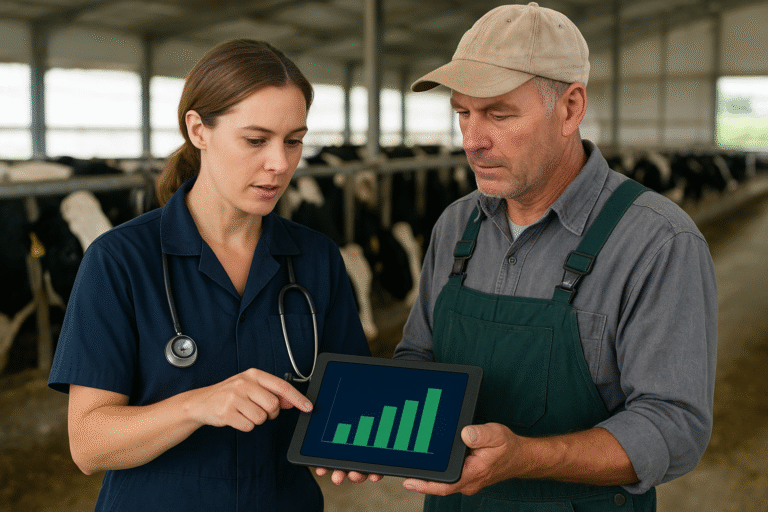
The intelligence-enhanced model operates differently. Veterinarians conduct bi-annual disease burden assessments that quantify current economic impacts by disease category. These findings anchor strategic consulting conversations about intervention priorities, expected outcomes, and resource requirements. Six months later, follow-up assessment validates whether implemented protocols are working. This creates a continuous cycle: measure, intervene, validate, adjust. The veterinarian remains involved throughout as both clinical advisor and economic consultant.
This expanded scope creates new revenue opportunities for veterinary practices. Herd health optimization consulting can be structured as annual retainer services that include bi-annual disease burden assessments, intervention design support, and ongoing protocol monitoring. Rather than billing solely for farm visits and treatments, practices offer strategic advisory packages. A farm might pay $3,500 annually for comprehensive disease burden monitoring, quarterly consulting sessions, and access to data-driven management recommendations. That’s separate from—and additional to—clinical service fees for treating individual animals.
Intervention validation consulting represents another distinct service offering. Farmers implement new protocols constantly: different vaccination programs, altered feeding strategies, facility modifications, staff training initiatives. Most of these investments happen without quantified outcome measurement. Did the $12,000 spent on footbath system improvements actually reduce lameness-related milk losses? Disease burden analysis at six and twelve months post-intervention answers that question definitively. Veterinarians can offer “intervention effectiveness validation” as a discrete service that documents ROI for major farm investments (Owusu-Sekyere et al., 2023).
The value proposition shifts fundamentally. Traditional framing positions protocol improvements as costs: “You should invest in enhanced mastitis prevention.” That sounds like an expense competing against other farm needs. Intelligence-enhanced framing positions the same recommendation as an investment opportunity: “Mastitis currently costs your operation 22,000 liters annually—that’s $13,200 in invisible losses. Enhanced prevention protocols costing $4,500 could reduce losses by 40% based on similar farms. That would recover $5,280 in the first year alone, with continued savings in subsequent years.” Same recommendation, completely different economic framing enabled by quantified baseline data.
Client engagement follows natural cycles. Baseline assessment at Month 0 establishes current disease burden, identifies economic priorities, and informs intervention strategy design. Veterinarian and farmer collaboratively determine which disease to address first based on economic impact, trend direction, farmer readiness for change, and intervention feasibility. First checkpoint at Month 6 validates early outcomes. Maybe mastitis losses have decreased from 22,000 to 17,000 liters—a 23% reduction in six months. That builds farmer confidence in the data-driven approach and justifies continued investment. Alternatively, if losses haven’t decreased, the six-month window enables rapid pivot to different strategies without wasting a full year on ineffective protocols.
Second checkpoint at Month 12 confirms sustained improvement and documents full-year ROI. This is where veterinarians demonstrate quantifiable consulting value. A report might show: “Mastitis losses decreased from 22,000 to 13,000 liters over 12 months—a 41% reduction. That’s 9,000 liters recovered, worth $5,400 at current milk prices. Against your $4,500 protocol investment, you gained $900 net benefit in Year 1, with continued $5,400 annual savings in subsequent years.” Those numbers prove veterinary recommendations delivered measurable returns, not theoretical benefits.
Ongoing cycles maintain continuous improvement. After successfully addressing mastitis, attention shifts to the next priority—perhaps lameness or ketosis. The same measure-intervene-validate-adjust cycle applies. Over multiple years, systematic disease burden monitoring creates documented tracks of value delivery that strengthen long-term client relationships and justify premium pricing for consulting expertise.
Strategic advisory applications extend beyond individual disease interventions. Traffic light systems help prioritize when farmers face multiple challenges simultaneously. Red-flagged diseases with high losses and worsening trends demand immediate attention. Yellow-flagged conditions with stable losses can be monitored while focusing resources on red priorities. Green-flagged diseases with improving trends validate that current protocols should be maintained. This prioritization framework guides resource allocation discussions when farmers have limited capacity for implementing multiple changes at once.
Protocol effectiveness documentation builds practice-wide credibility. When you can demonstrate across multiple clients that veterinary-guided interventions consistently deliver 15-40% reductions in disease-related milk losses, your practice differentiates from competitors based on evidence rather than claims. Marketing materials can reference average ROI delivered to clients. New client acquisition becomes easier when you can cite specific examples: “We helped 12 dairy farms reduce mastitis losses by an average of $8,300 annually using systematic disease burden monitoring and targeted intervention strategies.”
The veterinary consulting evolution this enables is substantial. You’re not just diagnosing and treating sick animals. You’re quantifying economic losses from disease, designing prevention strategies based on data rather than intuition, validating that your recommendations work through before-and-after measurement, and documenting ROI that proves your value. That positions veterinarians as essential strategic partners in farm profitability, not merely animal health service providers responding to problems after they occur.
Implementing Six-Month Monitoring in Your Veterinary Practice
Integrating six-month disease burden monitoring into veterinary practice workflows requires strategic planning but delivers substantial returns. The implementation pathway focuses on pilot farm selection, baseline establishment, intervention design, and systematic follow-up that demonstrates value to both veterinarians and dairy clients.
Start with pilot farm selection. Identify two to three progressive dairy operations with accurate disease recording in DC305 or DairyComp systems. Data quality matters critically here. Farms that record disease events inconsistently or incompletely will generate unreliable analyses that undermine confidence in the approach. Look for operations where disease diagnosis and recording protocols are already strong. These farms need minimum five years of historical data to establish trend analysis and provide context for current findings.
Choose farms with motivated owners ready to implement protocol changes based on data recommendations. Pilot success depends on farmer engagement. You need clients who will actually adjust management practices when disease burden analysis identifies opportunities, not farms that want information but resist action. Progressive operations already investing in herd health are ideal candidates—they understand preventive value and typically respond well to evidence-based guidance.
Baseline assessment establishes current state. Run initial disease burden analysis to quantify existing milk losses by disease category, identify five-year trends, and determine traffic light status for each condition. Present findings focusing on economic impact rather than technical methodology. Farmers care about dollars more than statistical algorithms. Frame results like: “Mastitis currently costs your operation 18,000 liters annually—that’s $10,800 in invisible production losses. The five-year trend shows this worsening despite existing protocols, indicating current approaches need adjustment.”
Collaboratively identify intervention priorities based on multiple factors. Economic impact matters—diseases causing greatest losses deserve attention. But also consider trend direction (worsening trends demand urgency), farmer readiness for change (some protocol adjustments are easier to implement than others), and intervention feasibility (facility modifications might require capital availability). The goal is selecting a target disease where success is achievable within six months, building confidence for addressing additional challenges later.
Intervention design and implementation require clear documentation. Work with the farmer to design targeted protocol changes addressing the priority disease. Maybe this means enhanced early detection screening for mastitis, altered transition cow nutrition for ketosis prevention, or improved footbath protocols for lameness management. Document the intervention start date clearly—this becomes Month 0 in your monitoring timeline. Set measurable targets based on baseline data. If ketosis currently causes 12,000 liters annual loss, aim for 30-40% reduction within twelve months as a realistic goal.
Communicate the plan clearly to the farm team. Everyone needs to understand what changed and why. This isn’t just about buy-in, it’s about maintaining consistency during the monitoring period so you can accurately attribute outcome changes to protocol adjustments rather than random variation or other management shifts that happen concurrently.
Six-month checkpoint validation provides critical feedback. Run follow-up disease burden analysis to assess early outcomes. Present findings emphasizing both successes and areas needing adjustment. Maybe mastitis losses decreased from 18,000 to 13,500 liters—a 25% reduction in six months that’s clearly trending toward your twelve-month target. That validates the protocol is working. Alternatively, if losses remain at 17,500 liters with minimal change, the six-month checkpoint enables investigation and course correction. Was the protocol implemented as planned? Did compliance slip? Does the intervention need modification or do you need to try a different approach entirely?
Use six-month data to build farmer confidence in evidence-based approaches. Quantified early success creates momentum for continued investment. When a farmer sees documented proof that protocol changes recovered 4,500 liters worth $2,700 in just six months, confidence in your recommendations increases substantially. That makes subsequent suggestions about addressing other diseases more likely to receive investment and implementation commitment.
Continuous improvement cycles maintain long-term engagement. After successfully addressing the initial priority disease through twelve-month validation, shift focus to the next economic opportunity identified in baseline assessment. Apply the same cycle: establish baseline for the new target, design intervention, monitor at six months, validate at twelve months, document ROI. Over multiple years, this systematic approach creates progressively healthier herds with quantified proof of veterinary consulting value at every stage.
Expand to additional farms as pilot successes create proof-of-concept. Use results from early adopters to demonstrate value to other clients. When you can tell a prospective client: “We implemented six-month disease burden monitoring on three farms last year. All three reduced mastitis-related losses by an average of 35%, recovering $7,200 per farm in the first twelve months,” that creates powerful motivation for adoption. Early successes become your best marketing tool for practice-wide implementation.
Develop standardized service packages for scalable practice-wide deployment. Once you’ve refined the workflow through pilot farms, create structured offerings: “Herd Health Optimization Program—includes bi-annual disease burden assessment, quarterly consulting sessions, intervention design support, and twelve-month ROI documentation for $3,500 annually.” Package pricing makes the service accessible while ensuring adequate compensation for the strategic consulting value you’re providing.
Address adoption barriers proactively. Time investment concerns arise frequently—veterinarians worry about adding more work to already busy schedules. Emphasize that disease burden analysis is largely automated once data pipelines connect to farm management systems. Your time investment focuses on high-value interpretation, recommendation, and implementation support rather than manual data analysis. Bi-annual reviews require perhaps two hours per farm per cycle—manageable when structured as distinct consulting sessions separate from routine clinical visits.
Farmer skepticism about “more data” gets addressed by leading with economic impact. Don’t present this as another report to read. Frame it as intelligence that answers the specific question every farmer asks: “Is this protocol working, and is it worth the investment?” When you can answer definitively with quantified milk loss changes and dollar figures, data becomes decision-making power rather than information overload.
Protocol compliance challenges benefit from six-month checkpoints functioning as accountability touchpoints. Knowing that effectiveness will be measured in six months helps maintain implementation consistency. It’s harder for protocols to drift when farmers and staff know objective assessment is coming. This built-in accountability mechanism helps sustain behavior change that improves herd health outcomes.
Conclusion
Six-month assessment cycles transform disease monitoring from descriptive case tracking to analytical economic intelligence. This timing isn’t arbitrary—it’s biologically and financially optimized to capture full disease-recovery cycles while maintaining intervention agility that prevents cumulative losses from compounding unnecessarily.
Disease burden analysis operating on six-month intervals creates the decision-intelligence layer that veterinarians need for strategic consulting. You’re no longer guessing whether protocols work or waiting twelve months for retrospective confirmation. Every six months provides a clinical-economic checkpoint that quantifies disease costs, validates intervention effectiveness, and guides adaptive management decisions based on evidence rather than assumptions.
This approach doesn’t transform veterinarians into consultants exclusively—it adds data-driven intelligence to existing clinical expertise. The recurring six-month touchpoints create ongoing engagement opportunities, demonstrate measurable ROI through quantified milk loss reductions, and build long-term practice value through documented tracks of delivering farm profitability improvements. When you can prove that your recommendations recovered 9,000 liters worth $5,400 on a client’s farm, you’ve established strategic consulting credibility that extends well beyond treatment services.
The key insight remains consistent throughout: every disease event is a production event. Six-month assessments quantify what those production events cost, enabling veterinarians to speak the economic language that drives farm-level decisions. When herd health data becomes decision intelligence through systematic monitoring cycles, disease management becomes a competitive advantage for progressive dairy operations and the veterinary practices that serve them.
Ready to add economic intelligence to your veterinary consulting? Download our disease burden monitoring service guide to learn how six-month assessment cycles can strengthen client relationships while delivering quantifiable farm profitability improvements. Visit our Disease Burden Analysis tool page to explore how systematic monitoring transforms clinical data into strategic consulting opportunities.
References
Owusu-Sekyere, E., Hansson, H., and Telezhenko, E. (2023). Dairy cow longevity: Impact of animal health and farmers’ investment decisions. Journal of Dairy Science, 106(5), 3207-3220. https://www.journalofdairyscience.org/article/S0022-0302(23)00162-5/fulltext
Puerto, M.A., Shepley, E., Cue, R.I., Warner, D., Dubuc, J., and Vasseur, E. (2021). The hidden cost of disease: I. Impact of the first incidence of mastitis on production and economic indicators of primiparous dairy cows. Journal of Dairy Science, 104(7), 7932-7943. https://www.journalofdairyscience.org/article/S0022-0302(21)00510-5/fulltext
Rasmussen, P., Barkema, H.W., Osei, P.P., Taylor, J., Shaw, A.P., Conrady, B., Chaters, G., Muñoz, V., Hall, D.C., Apenteng, O.O., Rushton, J., and Torgerson, P.R. (2024). Global losses due to dairy cattle diseases: A comorbidity-adjusted economic analysis. Journal of Dairy Science, 107(9), 6945-6970. https://www.journalofdairyscience.org/article/S0022-0302(24)00821-X/fulltext
Wilson, D.J., González, R.N., Hertl, J., Schulte, H.F., Bennett, G.J., Schukken, Y.H., and Gröhn, Y.T. (2004). Effect of clinical mastitis on the lactation curve: a mixed model estimation using daily milk weights. Journal of Dairy Science, 87(7), 2073-2084. https://www.sciencedirect.com/science/article/pii/S0022030204700259
Related Resources:
About DairyCommand
From our family to yours: DairyCommand was built by veterinarians and data scientists who understand both clinical excellence and farm economics. Our Disease Burden Analysis tool transforms complex herd data into decision intelligence, enabling veterinarians to quantify disease costs, validate interventions, and demonstrate measurable consulting value. We believe six-month assessment cycles provide the biological and financial optimization that modern dairy operations need—capturing full disease cycles while maintaining the agility to adapt quickly when protocols need adjustment. Learn more about our veterinary consulting tools at signal2action.com.