
The $18,000 Hidden Pitfall Most Farmers Miss
For illustration purposes, we have a hypothetical farmer named Sarah, who runs a 150-cow dairy operation in Ontario. Last year, she bred 42 cows based on what looked like solid production numbers. Good current milk yields, decent genetic scores, reasonable health records.
Six months later, her consultant ran a lifetime analysis on those breeding decisions. The results surprised her. Twelve of those cows had hidden trajectories showing they’d already peaked. Another eight showed patterns of declining production masked by one good test day.
Those 20 breeding decisions represented roughly $18,000 in lost genetic improvement and extended time to first calving for replacement heifers. The cows looked fine on paper. Their lifetime data told a different story.
Research shows cow longevity directly impacts farm economic performance, with increased lifetime milk production of culled cows showing significant positive associations with gross margins (Vredenberg et al., 2021).
This isn’t about management quality. Sarah’s doing everything traditional dairy management recommends. She’s checking genetic scores, reviewing test day results, consulting with her vet.
The issue? Traditional systems only show you snapshots. They can’t reveal what really matters: where each cow is in her lifetime production journey and whether she’s actually worth breeding.
Why Current Production Numbers Hide The True Value?
Walk into most dairy operations, and you’ll see farmers making breeding decisions based on three things: this month’s milk yield, the most recent genetic evaluation, and whether the cow looks healthy.
Sounds logical. Here’s why it fails.
A cow producing 85 pounds of milk today could be on three completely different paths. She might be a second-lactation cow hitting her stride, with three more productive years ahead. Or she could be a fourth-lactation cow already declining, just having one last good month. Or she might be a first-lactation cow who’ll never reach full potential due to hidden health issues affecting her milk production trajectory.
All three cows show the same dairy production today. Their lifetime value? Completely different.
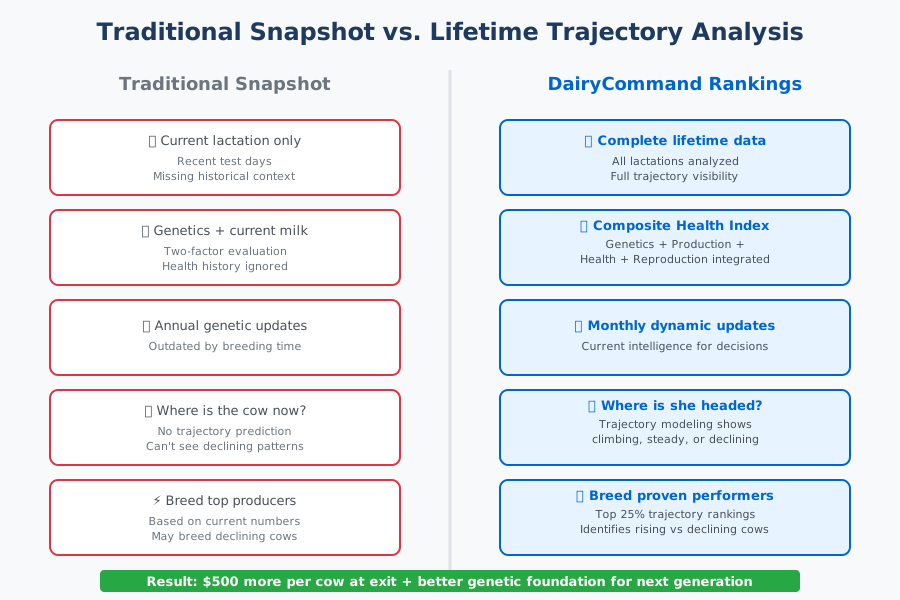
Traditional genetic evaluations don’t help much here either. They’re updated annually, static snapshots that tell you breeding potential but nothing about actual performance trajectory. Studies using longitudinal data analysis show that genetic correlations between dairy cow performance at different ages can drop below 0.7 for measurements five or more years apart, meaning early genetic predictions often fail to capture lifetime performance patterns (Oliveira et al., 2019).
You’re making permanent breeding decisions based on temporary data.
The Lifetime Trajectory Revolution: What Monthly Rankings Reveal
Here’s what changes when you analyze lifetime production trajectories instead of current snapshots.
DairyCommand’s Cow Performance Ranking System tracks every cow’s complete production history. Not just last month. Not just this lactation. Every test day, every health event, every reproductive outcome since she entered your herd.
Then it does something traditional systems can’t. It identifies her trajectory, whether she’s climbing toward peak production, maintaining steady output, or declining despite current numbers that still look acceptable.
How the Trajectory Analysis Works
The system compares each cow’s actual performance against the herd average lifetime curve. Think of it like a GPS for milk production. You’re not just seeing where the cow is today. You’re seeing whether she’s ahead of schedule, on track, or falling behind relative to her potential.
This matters because peak production timing varies dramatically between cows. Some animals hit their stride in second lactation. Others don’t fully mature until third or fourth. Traditional snapshot evaluations miss this completely.
Research demonstrates that analyzing dairy cattle performance using longitudinal models captures trajectory information that single-measurement or short-term evaluations cannot detect, leading to more accurate lifetime production projections (Adamczyk et al., 2024).
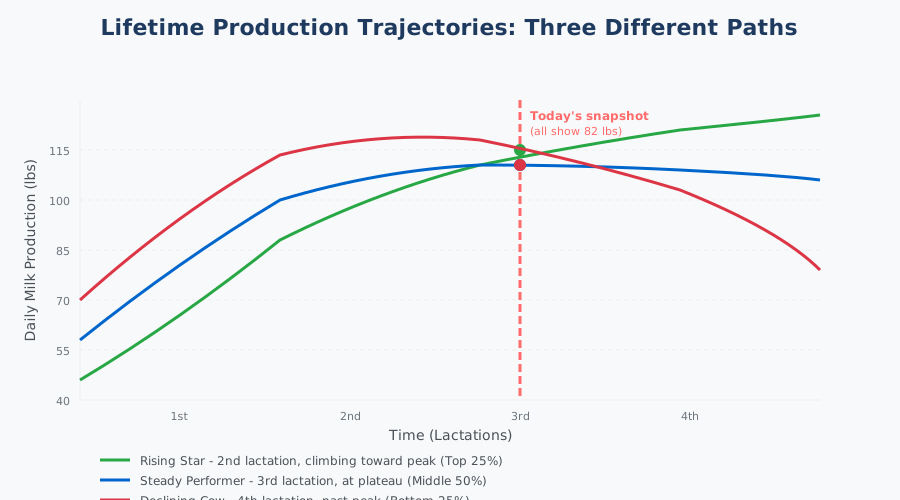
The real breakthrough? Monthly updates. Your cow rankings refresh every month as new data comes in. You’re not waiting a year for genetic re-evaluations. You’re getting current intelligence about which cows justify breeding investment based on their actual, proven performance paths.
The Cow Performance Ranking Score: Beyond Genetics and Milk Alone
Most breeding decisions weigh two factors heavily: genetic scores and current production. Some farmers add reproductive efficiency to the mix.
This leaves out the single biggest profit killer in dairy operations. Disease burden and health trajectory.
DairyCommand’s Cow Performance Ranking includes a proprietary Cow Performance Score that integrates lifetime health events, disease patterns, and production resilience into one score. It’s not just tracking whether a cow got sick. It’s analyzing how disease history impacts her lifetime trajectory and future profitability.
What the Health Index Reveals
A cow might show good current production and solid genetics. But if her health history includes recurring mastitis in early lactations, her trajectory analysis reveals she’s producing 8-12% below potential. The lost production doesn’t show up on this month’s milk check. It’s invisible in standard financial records.
Until you breed her and pass those disease susceptibility patterns to the next generation.
The Cow Performance Score catches this. It identifies cows whose lifetime production trajectories show disease-related deviations from the herd average trajectory. Then it flags them in monthly rankings so you’re not accidentally breeding animals with less resilient health patterns into the next generation.
Studies examining economic impacts of dairy cow performance show that health events create lasting effects on lifetime production that extend well beyond the immediate lactation, with proper lifetime dairy production analysis revealing patterns invisible in conventional evaluation systems (Owusu-Sekyere et al., 2023).
This is the critical difference between snapshot evaluation and lifetime trajectory analysis. A snapshot shows you a cow that recovered from disease and resumed production. Trajectory analysis shows you a cow whose lifetime curve permanently dropped after that health event. She’ll never reach the production she would have achieved without it.
That distinction determines whether she deserves your limited breeding doses of sexed semen or should be bred with beef semen instead.
Monthly Rankings vs. Annual Genetic Evaluations: A Real-World Comparison
Let’s compare two cows using traditional evaluation versus lifetime trajectory ranking.
Traditional Snapshot Approach:
Cow #347:
- Current production: 82 lbs/day
- Genetic index: +850 (above herd average)
- Health status: No current issues
- Breeding decision: Use sexed semen, retain heifer calves
Cow #891:
- Current production: 76 lbs/day
- Genetic index: +720 (average)
- Health status: One mastitis case last year
- Breeding decision: Breed with conventional semen or beef
Seems straightforward. Cow #347 outperforms #891 on every conventional measure.
Lifetime Trajectory Analysis:
Cow #347:
- Current production: 82 lbs/day
- Lifetime trajectory: Peak performance, now declining (4th lactation)
- Trajectory analysis: 3% below the herd average curve this lactation, pattern shows consistent early-lactation drops
- Health Index: Below average due to recurring subclinical ketosis
- Monthly ranking: Bottom 30% of herd
- Breeding recommendation: Beef semen. Sell while she still has value
Cow #891:
- Current production: 76 lbs/day
- Lifetime trajectory: Climbing steadily (2nd lactation)
- Trajectory analysis: 5% above the herd average curve, consistent overperformer relative to genetics
- Health Index: Above average despite single mastitis event (responded well, no recurrence)
- Monthly ranking: Top 25% of herd
- Breeding recommendation: Sexed semen. Prime candidate for genetic improvement
Everything flips when you see the complete picture.
Cow #347 had one good current number hiding a declining trajectory. Breeding her perpetuates animals that peak early and drop fast. Cow #891’s lower current production masks that she’s actually exceeding expectations and trending up. She’s the genetic foundation you want to build on.
Traditional evaluations would lead you to prioritize the wrong cows for your breeding program.
The Market Opportunity Farmers May Miss
Here’s an insight that changed how we think about cow rankings: not every cow in your bottom tier is worthless. Some are actually valuable, just not to you.
A cow ranking in your herd’s bottom 30% might still be an average to above-average performer compared to regional benchmarks. She’s underperforming relative to YOUR herd’s genetic level and management quality, but she’d be perfectly profitable in an operation with different goals or production systems.
This creates a market opportunity traditional culling decisions miss. Instead of sending bottom-ranked cows to beef markets at $1,200-1,500, you can identify which ones to sell as dairy animals to other operations for $2,000-2,500.
The ranking system identifies these animals by comparing herd-level trajectories to individual cow trajectories. A cow might be below your herd average but still showing stable production and decent health scores. She’s not a breeding candidate for your operation, but she’s not beef market material either. She’s a sale opportunity.
Over a year, this distinction adds up. A 150-cow operation typically culls 25-35 animals annually. If ranking analysis helps you identify even five cows per year that can be sold as dairy animals instead of beef, that’s $5,000-6,500 in additional revenue. Plus you’re selling them earlier in their decline, capturing more value before production drops further.
How Monthly Updates Drive Better Reproductive Strategies
The monthly refresh schedule isn’t just a convenience feature. It’s a fundamental improvement in how breeding decisions get made.
Traditional genetic evaluations update annually. Your vet visits monthly or quarterly. Test day results come every 4-6 weeks. None of these cycles align with your actual breeding schedule.
You’re making breeding decisions every week. Determine which cows get sexed semen this cycle? Identify which get conventional? Decide which gets beef semen? You need current cow performance scores to drive those decisions, not six-month-old genetic scores.
Monthly cow rankings give you intelligence that matches your operational rhythm. New rankings arrive right as you’re scheduling the next breeding round. Cows that looked promising last month but show a concerning trajectory shifts this month get flagged before you make expensive sexed semen decisions.
This matters more as genetic prices climb. Quality sexed semen runs $25-45 per dose. Conventional breeding costs $15-25. Beef semen is $8-12. Multiply those differences by 40-50 breeding decisions per month, and poor timing on cow selection costs serious money.
The monthly cycle also catches seasonal effects that annual evaluations miss. A cow showing strong summer performance might reveal winter trajectory problems as the year progresses. Monthly rankings adapt to these patterns. Annual genetic evaluations don’t update until it’s too late to adjust breeding strategy.
Integrating Health Data: The Missing Link in Breeding Decisions
Most dairy farming management systems track health events. Mastitis cases get recorded. Ketosis treatments get logged. Lameness episodes go in the system.
Then those records sit unused when breeding decisions happen. Genetic scores and milk production drive selections. Health history is an afterthought, considered only if a cow has obvious current problems.
This disconnect costs farms genetic progress. You’re not just breeding for production and genetic merit. You’re inadvertently breeding for disease susceptibility if you ignore health trajectory patterns.
DairyCommand’s ranking system integrates health events, including reproductive health as well, into the trajectory analysis and monthly rankings. When a cow experiences health issues, the system doesn’t just flag it as a problem. It analyzes how that event affected her production trajectory relative to her predicted curve.
Some cows experience health events with minimal production impact. They respond to treatment, return to their expected trajectory, and maintain lifetime performance. Others show lasting effects. Production curves that permanently shift below potential even after apparent recovery.
The difference determines breeding value. A cow with resilient health trajectory patterns is worth breeding despite occasional health events. She passes resistance to her offspring. A cow with fragile health patterns should be bred to beef regardless of current genetic score. She’ll perpetuate animals that struggle with health challenges.
Analysis of dairy farm economics demonstrates that pregnancy rates and reproductive efficiency show stronger relationships with profitability than many traditional production metrics, particularly when evaluated across multiple lactations rather than in isolation (Dos Santos et al., 2025).
This health integration creates a complete profitability picture. You’re not choosing between cows with good genetics OR good health trajectories. You’re identifying cows with BOTH. The animals that combine genetic merit with proven performance resilience.
Those are the cows that build sustainable, profitable herds that you can confidently pass to the next generation.
Practical Implementation: Making Rankings Work on Your Farm
Understanding cow rankings helps. Using them effectively requires integration into your current workflow.
Here’s how progressive farms implement monthly ranking analysis without disrupting existing operations.
Step 1: Establish Your Baseline
Run your first ranking analysis on current herd composition. This establishes where every cow stands relative to herd average trajectories. You’re not making immediate changes. You’re learning your herd’s distribution.
Most farms may discover they have 20-25% of cows ranking in the top tier, 50-60% in the middle range, and 20-25% in the bottom tier. If your distribution differs significantly, that itself is valuable intelligence about herd management effectiveness and opportunities for improvement.
Step 2: Align Rankings with Breeding Cycles
Schedule ranking updates to arrive 3-5 days before your next breeding cycle begins. This gives you time to review changes and adjust breeding protocols before you start making decisions.
Look specifically for cows whose rankings shifted significantly from last month. A cow dropping from top tier to middle tier might have experienced a health event or trajectory change requiring breeding strategy adjustment. A cow climbing from bottom to middle tier might now justify conventional breeding instead of beef semen.
Step 3: Create Breeding Protocol Tiers
Establish clear guidelines for how rankings drive breeding decisions:
- Top 25% of herd: Sexed semen candidates. These are your genetic future. Retain and breed these animals for herd improvement.
- Middle 50% of herd: Conventional semen. These animals maintain herd production but aren’t optimal for genetic advancement. Breed for replacement needs.
- Bottom 25% of herd: Beef semen or early sale decisions. These animals should exit the herd. Use rankings to determine whether they’re sale candidates (dairy market) or beef market animals.
These tiers aren’t rigid rules. Your vet, nutritionist, and management experience still matter. Rankings provide data-driven starting points for discussions, not mandates that override common sense.
Step 4: Track Decision Outcomes
This step separates farms that get value from rankings versus those that don’t. Track which cows you breed to sexed semen, which get conventional, which get beef. Then compare actual outcomes to predicted trajectories.
Track whether the top-ranked cows bred to sexed semen maintained or improved their trajectories. See if middle-tier cows bred to conventional justified that decision. Confirm that bottom-tier cows bred to beef continued declining as rankings predicted.
This feedback loop shows whether your breeding decisions align with trajectory analysis or whether you’re overriding rankings based on biases that aren’t serving your operation.
The Economics: What Monthly Rankings Actually Cost vs. Return
Let’s talk numbers. What does lifetime trajectory analysis and monthly cow ranking actually cost you? And what return can you expect?
The Investment
DairyCommand’s Cow Performance Ranking requires access to your herd management data (most farms already use DC305 or similar systems), historical production records (minimum 2-3 lactations ideal), and monthly data updates.
For most operations, this represents time investment more than direct costs. You’re already collecting the data. The system analyzes it and delivers rankings. Your main investment is the discipline to consider rankings when making breeding decisions instead of defaulting to traditional snapshot evaluation.
The Return
A 150-cow operation breeding 120-140 animals annually can expect these outcomes:
- Improved sexed semen allocation: Better identification of top-tier breeding candidates typically reduces sexed semen waste by 6-8 doses annually. At $30-40 per dose, that’s $180-320 in avoided cost from not breeding declining cows with premium semen.
- Enhanced conventional breeding efficiency: Middle-tier animals bred conventionally instead of with beef (due to rankings revealing better trajectories than snapshots suggested) typically add 3-4 replacement heifers per year worth $1,800-2,000 each. That’s $5,400-8,000 in retained replacement value.
- Dairy market sales vs. beef market: Rankings help identify 4-6 bottom-tier cows annually that can sell as dairy animals to other operations instead of beef market. At $1,000-1,200 premium per animal, that’s $4,000-7,200 additional revenue.
- Reduced involuntary culling: Better health trajectory analysis typically reduces involuntary culls by 2-3 animals annually by identifying and removing cows with declining health patterns before crisis. Each avoided involuntary cull saves roughly $500-800 in lost replacement value. That’s $1,000-2,400 in savings.
Total annual benefit for a 150-cow operation: $10,580-17,920. That’s $70-120 per cow per year in improved decision-making value.
These aren’t projections. They’re outcomes farms may actually see when they implement trajectory-based breeding decisions using monthly cow rankings.
Beyond Breeding: How Rankings Improve Overall Herd Management
Breeding decisions represent the most obvious application of monthly cow rankings. But trajectory analysis impacts several other areas of herd management.
Culling Timing Optimization
Traditional culling decisions happen when a cow’s production drops below a threshold or health problems accumulate. Rankings show you which cows to remove earlier, animals whose trajectories predict continued decline even though current production still looks acceptable.
Early removal captures more market value and prevents resources being spent on cows with diminishing returns. You’re not culling based on failure. You’re optimizing based on trajectory.
Nutrition and Health Protocol Targeting
When rankings reveal clusters of cows showing similar trajectory deviations, it signals systemic issues requiring management attention.
Six cows ranking in bottom tier with similar early-lactation trajectory drops? That’s probably a transition cow nutrition issue, not six individual animal problems. Rankings help you distinguish between animal-level issues requiring individual intervention and herd-level patterns requiring protocol changes.
Heifer Integration Planning
Knowing your ranking distribution helps you plan heifer integration strategy. If your herd shows 30% bottom-tier cows instead of expected 20-25%, you need more replacement heifers entering the milking string. If only 15% rank bottom tier, you can be more selective about which heifers to bring in and which to sell as breeding stock.
This affects heifer rearing costs, facility planning, and cashflow management. Rankings give you advance notice to adjust instead of reacting when you suddenly realize you’re short on quality replacements.
Getting Started: First Steps with Lifetime Trajectory Analysis
You’re convinced trajectory analysis beats snapshot evaluation. You see how monthly rankings could improve your breeding decisions.
Where do you start?
Audit Your Current Data Quality
Trajectory analysis requires clean historical data. Before you can rank cows based on lifetime performance, verify your system has:
- Complete production records for at least two lactations per cow
- Accurate health event recording (dates, treatments, outcomes)
- Reliable reproductive history (breeding dates, pregnancy checks, calving records)
- Genetic evaluations for breeding animals
Most farms using modern herd management software already have this data. If you’re missing significant historical records, start improving data quality now while you prepare for trajectory analysis implementation.
Request Your First Ranking Analysis
Schedule a comprehensive herd evaluation. This generates initial rankings for every cow based on lifetime trajectories, establishes your herd’s distribution across ranking tiers, and identifies immediate opportunities for breeding decision improvements.
Review results with your veterinarian. Their clinical knowledge combined with trajectory data creates the complete picture needed for strategic decisions.
Implement for One Breeding Cycle
Don’t try to revolutionize your entire operation overnight. Use rankings to guide breeding decisions for one complete cycle. Track outcomes. Compare cows bred using trajectory analysis to cows bred using traditional methods.
This pilot approach builds confidence in the system while minimizing risk. You’re testing trajectory analysis on a subset of decisions before committing your entire breeding program.
Establish Monthly Review Protocol
Set up a consistent monthly review routine. Same day each month, review updated rankings, identify significant trajectory changes, adjust breeding protocols for upcoming cycle, and track your decisions (top, middle, bottom) outcomes against the algorithmic cow performance ranking (top, middle, bottom).
This discipline, more than any other factor, determines whether you get value from lifetime trajectory analysis. Rankings that sit unreviewed provide zero benefit. Rankings reviewed monthly and integrated into decisions drive measurable improvement.
Real Results: What Farms May See
Talk is cheap. Data matters. Here’s what operations implementing monthly cow rankings actually experience.
Ontario Operation (150 cows, mainly Holstein)
Before rankings: Breeding decisions based primarily on current production and annual genetic evaluations. Sexed semen used on 45-50 cows annually based on top milk yield and genetic scores.
After six months of monthly rankings: Sexed semen allocation dropped to 38-42 cows (more selective breeding of true top performers). Beef semen breeding increased from 12 to 19 animals annually (better identification of bottom-tier animals). Five cows sold as dairy animals that would previously have gone to beef market.
Financial impact: $12,400 improvement in annual breeding program efficiency plus replacement value.
Quebec Operation (280 cows, mixed breeds)
Before rankings: Relied heavily on consultant recommendations and genetic scores. Involuntary culling rate 15-16% annually due to health issues not caught early enough.
After implementing trajectory analysis: Involuntary culling dropped to 11-12% through earlier identification of cows with declining health trajectories. Heifer retention improved by identifying which young cows showed strong early trajectories vs. which would likely underperform.
Financial impact: $18,700 reduction in losses from involuntary culls plus improved replacement heifer quality.
These aren’t maximum-potential scenarios from perfect implementations. They’re early results from farms still learning the system while improving their breeding decisions.
The Bottom Line: Why Lifetime Trajectory Analysis Matters
You can keep making breeding decisions based on last month’s milk yield and last year’s genetic evaluation. Many farms do. Some succeed despite incomplete information.
Or you can see the complete picture. Every cow’s lifetime performance trajectory. How current production compares to the herd average curves. Whether health events created lasting impacts or temporary setbacks. Which animals justify premium breeding investment and which need to exit the herd while they still have market value.
That’s not a luxury for large operations with data science teams. It’s practical intelligence every dairy farm can access and use to make better breeding decisions every month.
The genetic foundation you build today determines your herd’s profitability for the next decade. Traditional snapshot evaluations leave you working with incomplete information. Lifetime trajectory analysis lets you breed based on proven performance, not hopeful projections.
From our family to yours: you work too hard to select breeding animals based on partial data. Your cows deserve evaluation systems that reveal their true value, not just their current numbers.
See Your Herd’s Cow Rankings
Ready to see which of your cows truly deserve your best genetics? Request a comprehensive Cow Performance Ranking analysis for your herd.
We’ll analyze your historical data, generate lifetime trajectory rankings for every cow, identify immediate breeding decision opportunities, and deliver monthly updated rankings aligned with your breeding cycle.
See your herd’s cow rankings →
Initial analysis includes complete trajectory evaluation, Cow Performance Scoring for every cow, breeding recommendation tiers, and three months of updated rankings to validate results.
Learn More About DairyCommand
- Cow Performance Ranking System – Complete tool overview and capabilities
- Compare Our Tools to Traditional Methods – See what sets DairyCommand apart
- Request a Herd Analysis – Get your first cow ranking report
References
Adamczyk, K., Pokorska, J., Makulska, J., Earley, B., & Mazurek, M. (2024). Data-driven prediction of dairy cattle lifetime production and its use as a guideline to select surplus youngstock. Journal of Dairy Science, 107(4), 2156-2171. https://www.journalofdairyscience.org/article/S0022-0302(24)00069-9/fulltext
Dos Santos, J. B., de Freitas, B. W., Obando, I. A. M., de Oliveira, N. D., Penitente-Filho, J. M., Moreira, M. V. C., Lobato, A. N., & Guimarães, J. D. (2025). Reproductive traits and economic aspects on dairy cattle. Animal Reproduction, 22(1), e20240050. https://doi.org/10.1590/1984-3143-AR2024-0050
Oliveira, H. R., Brito, L. F., Silva, F. F., Lourenco, D. A. L., Jamrozik, J., & Schenkel, F. S. (2019). Genomic prediction of lactation curves for milk, fat, protein, and somatic cell score in Holstein cattle. Journal of Dairy Science, 102(1), 452-463. https://doi.org/10.3168/jds.2018-15159
Owusu-Sekyere, E., Nyman, A. K., Lindberg, M., Adamie, B. A., Agenäs, S., & Hansson, H. (2023). Dairy cow longevity: Impact of animal health and farmers’ investment decisions. Journal of Dairy Science, 106(6), 3509-3524. https://www.sciencedirect.com/science/article/pii/S0022030223001625
Vredenberg, I., Han, R., Mourits, M., Hogeveen, H., & Steeneveld, W. (2021). An empirical analysis on the longevity of dairy cows in relation to economic herd performance. Frontiers in Veterinary Science, 8, 646672. https://www.frontiersin.org/journals/veterinary-science/articles/10.3389/fvets.2021.646672/full